Showing posts with label Jim Jarmusch. Show all posts

Friday, August 13, 2021

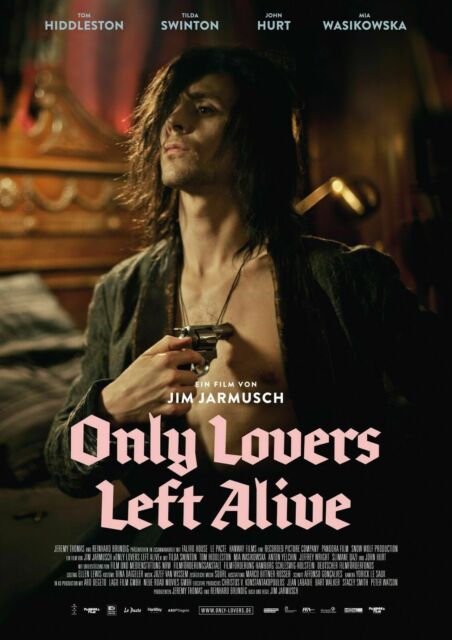
#2,599. Only Lovers Left Alive (2013)


Written and directed by Jim Jarmusch, Only Lovers Left Alive is an intensely unique and utterly fascinating vampire movie, portraying the undead not as tortured souls or bloodsucking monsters but as witnesses to history, who have learned to appreciate art, literature, music, and what it truly means to be alive.

Adam (Tom Hiddelston), a centuries-old musician / vampire, resides in Detroit. His wife Eve (Tilda Swinton) lives in Tangiers, and while she enjoys her occasional visits with old friend and fellow vampire Christopher “Kit” Marlowe (John Hurt), she misses her beloved.

So Eve hops a nighttime flight to America and reunites with her husband of many, many years. But Eve’s troublesome sister Ava (Mia Wasikowska) has somehow tracked them down, and her flighty attitude threatens not only Adam and Eve’s happiness, but their everlasting lives as well.

With extraordinary performances throughout, Only Lovers Left Alive paints an idyllic portrait of a vampire’s existence, depicting them as advanced beings who have taken full advantage of the centuries, experiencing all that the world has (and had) to offer. Adam is an accomplished musician in nearly every musical style, while Eve reads a wide variety of books, printed in dozens of languages. They are not merely the bloodthirsty undead; Adam and Eve are poets, scholars, and as engaging as any movie characters I have ever encountered.

Relying on his patented low-key approach, Jarmusch has crafted a singular motion picture; not since The Lost Boys has a movie made vampirism look so damned appealing!
Rating: 10 out of 10


Thursday, January 21, 2021

#2,528. The Dead Don't Die (2019)


The 2019 zom-com The Dead Don’t Die strikes the perfect balance between a genre outing and a Jim Jarmusch film, and I had a great time watching it!

The normally quiet town of Centerville is thrown into chaos when the dead start rising from their graves. Police Chief Cliff Robertson (Bill Murray) and his deputies Ronnie (Adam Driver) and Mindy (Chloe Sevigny) do what they can to protect their town, but it’s Zelda Winston (Tilda Swinton), Centerville’s very strange funeral director, who might ultimately prove most useful in defeating the zombie horde.

The Dead Don’t Die gives us the macabre and the quirky in equal measure. The characters, played by such Jarmusch regulars as Murray, Driver, Tom Waits (as Hermit Bob, a vagrant who patrols the nearby woods), and a few others are always interesting, and that little trait that the director gives his zombies - each one uttering a single word that encapsulates what we assume was most important to them while they were alive - was a nice touch (the first two zombies, played by Iggy Pop and Sara Driver, can only say “coffee”, which might explain why they attacked the local diner). All of the citizens of Centerville are a little bizarre, but none more so than Tilda Swinton’s Scottish undertaker, and I loved where they ultimately went with her character.

Headshots and all, The Dead Don’t Die is still very much a Jim Jarmusch film; the morning after the attack at the diner, Chief Robertson is called to the scene, where he makes the gruesome discovery. Before long, both of his deputies also turn up and walk into the diner - one by one - to see the carnage for themselves. In most other films, we’d only see the mutilated corpses when Chief Robertson arrived, then the faces of Donnie and Wendy after the fact, when they walked back out. But Jarmusch spends time with his characters, and follows each one inside to give us their initial reactions to the bloody mess in front of them (by doing so, we, the audience, see the gory outcome of the undead attack three separate times).

But The Dead Don’t Die is a zombie flick as well, with all the high drama and dread that goes hand-in-hand with the subgenre (in one very intense scene, Chief Robertson is finishing off as many of the walking dead as he can when he happens upon a zombie who used to be a good friend).

I really enjoyed The Dead Don’t Die, so much so that I’d now rank it right up there with Mystery Train and Dead Man as one of my favorite Jim Jarmusch films.
Rating: 9 out of 10 (see it immediately!)


Sunday, February 7, 2016

#2,001. Tigrero: A Film That Was Never Made (1994)


Directed By: Mika Kaurismäki

Starring: Samuel Fuller, Jim Jarmusch


Trivia 1: "This entire film was shot on-location in Brazil"

Trivia 2: It was Samuel Fuller's wife, Christa Lang Fuller, who came up with the idea for this film


Along with being an exemplary screenwriter and director, Samuel Fuller was also an amazing storyteller. With his raspy voice and straightforward delivery, he could spin a yarn better than most filmmakers of his generation, and his version of what occurred when he and Fox studio head Darryl Zanuck met with FBI chief J. Edgar Hoover, to review the script for 1953’s Pickup on South Street, remains one of my all-time favorite Hollywood anecdotes (you can hear it yourself on the Criterion DVD release of that great film). His 2004 autobiography, A Third Face, contains many similarly intriguing stories, and while I was reading it a few years ago, I tried to imagine that Fuller himself was narrating it (which made an already fascinating book even more entertaining).

Tigrero (subtitled A Film That Was Never Made) follows the legendary filmmaker as he and fellow director Jim Jarmusch (Mystery Train) travel to Brazil, specifically the small village of Santa Isabel Do Morro (situated along the Araguaia River), which Fuller, while scouting locations for a motion picture, had visited 40 years earlier. Armed with only a 16mm camera, Fuller got to know the native Karajás quite well during that initial trip, and as a result, they granted him unrestricted access to their village, and even let him film some of their ancient rituals. Ultimately, the picture was scrapped by Fox president Darryl Zanuck, but the footage Fuller shot still survives. Joined by Jarmusch, Fuller revisits this remote locale, and recalls fondly the unproduced movie that brought him there in first place.

Though primarily a documentary, 1994’s Tigrero (written and directed by Mika Kaurismäki) does feature some scripted scenes (including the opening sequence, when Fuller and Jarmusch are discussing their upcoming trip). Once they reach Santa Isabel Do Morro, however, Tigrero is in full documentary mode, with Fuller commenting on how the village and its people have changed over the years (much of the foliage that surrounded the area has been cut down, and the Karajás now enjoy such modern luxuries as TV and telephones). Then, in what is easily the best scene in Tigrero, Fuller shows the Karajá the decades-old footage he shot when he was last there, during which a few of them recognize friends and relatives that have long since passed away.

Most of Tigrero, though, consists of Fuller recounting his initial visit to the area, and offering a few details about the motion picture he was planning to make there (titled Tigrero, it was an action / adventure that was going to star John Wayne, Ava Gardner, and Tyrone Power. Unfortunately, the insurance company, nervous about the location Fuller had selected, demanded $16 million in advance, causing a frustrated Zanuck to shut it down). In addition, Fuller interviews the Karajá, asking what they thought of the footage he had just shown them (one woman spotted her late husband in a scene, and reflects on the good times they had together). Interestingly enough, some of these images would appear in Fuller’s own 1963 movie Shock Corridor.

Tackling topics such as culture, progress, and the art of filmmaking, Tigrero is a thought-provoking documentary starring one of the most charismatic storytellers of the 20th century.


Friday, December 30, 2011

#501. Mystery Train (1989)


Directed By: Jim Jarmusch

Starring: Masatoshi Nagase, Youki Kudoh, Screamin' Jay Hawkins


Trivia:  The hotel where the three stories converge is no longer standing, so many fans of the movie have made pilgrimages to the site only to find that it no longer exists.


Mystery Train is my favorite Jim Jarmusch film. I enjoy everything about this offbeat little movie, from the way it skillfully ties its three-part story together, to its down and dirty depiction of Memphis, long considered the birthplace of Rock and Blues music, yet presented here in a way it's never been seen before. This is not the Memphis made popular by Elvis Presley, Roy Orbison or Sun Records. In Mystery Train, we visit areas of the city its Tourism Council would sooner forget exist.

Named after a popular Elvis Presley song, Mystery Train relates three separate Memphis experiences. Jun (Masatoshi Nagase) and Mitsuko (Youki Kudoh) have just arrived from Japan, armed with both an extensive knowledge of Rock Music and a burning desire to see where Elvis got his start. They're young and optimistic, and aren’t the least bit discouraged by the fact they don't speak a word of English. Luisa (Nicolette Braschi) just flew in from Italy to claim her late husband's remains. She ends up sharing a motel room with Dee Dee (Elizabeth Bracco), an energetic young woman who recently walked out on her husband, Johnny (Joe Strummer). Nicknamed “Elvis” because of his resemblance to the King, Johnny is mired in a deep depression. Aside from losing Dee Dee, he was also laid off from his job, and both his friend, Will (Rick Aviles), and brother-in-law, Charlie (Steve Buscemi), do their best to help Johnny snap out of his funk. As luck would have it, all of these characters check into the same motel for the night, a third-rate joint with a portrait of Elvis in every room. Even in this rundown area of town, the spirit of Elvis Presley lives, and that spirit will touch the lives of some of them before the night is out. 

In a 1984 interview with Film Comment magazine, Jarmusch said he was fond of what he termed the ‘post-industrial landscape’, believing a study of urban decay evokes a natural sadness while, at the same time, creating something quite beautiful. In Mystery Train, we go “off the beaten path”, away from Memphis' various tourist attractions. As Jun and Mitsuko make their way to Sun Studios, they pass dilapidated houses, abandoned storefronts and walls decorated with graffiti. When Luisa leaves an all-night diner, two shady men, one of whom just bilked her out of twenty dollars, follow her. Johnny, depressed over losing his woman and his job in the same day, gets drunk at a local bar, the kind of place where you feel a fight's always about to break out. This is the Memphis Jim Jarmusch chose to explore, the Memphis that fascinated him, and the enthusiasm he showed for this neglected corner of town was catching; I, too, was captivated by it. 

Mystery Train has everything you'd expect to find in a Jim Jarmusch film: the subtle humor, the urban setting, and characters that exude a genuine innocence. It has all this, and even throws in a visit from Elvis’ ghost for good measure. But the King’s apparition doesn’t hang around very long. Late at night, in one of the motel rooms, the spirit of Elvis materializes out of thin air, looks around and says, “Sorry, I must be in the wrong place”. 

Yes, ladies and gentlemen, as amazing as it may sound, not even Elvis Presley recognized Jim Jarmusch’s Memphis!


Monday, September 19, 2011

#409. Stranger Than Paradise (1984)


Directed By: Jim Jarmusch

Starring: John Lurie, Eszter Balint, Richard Edson


Trivia:  In the scene where Willie and Eddie pick up Eva from the Hot Dog stand, director Jim Jarmusch can be seen eating a hot dog while wearing a beanie in the background


Not much happens in Jim Jarmusch’s Stranger Than Paradise. Not much at all. We follow three people who spend a lot of time indoors, either watching television or playing cards. They live in New York City, visit Cleveland and eventually take a trip to Florida, yet in none of these places do they ever venture outside for any extended length of time. Technically, I suppose it’s not even accurate for me to say that they ‘live’ in New York. They exist in New York. They don’t ‘live’ anywhere. 

Eva (Eszter Balint) has just flown in from Budapest, and will stay a few days with her cousin, Willie (John Lurie), before moving on to Cleveland to live with their Aunt Lotte (Cecillia Stark). Willie, who desperately wants to distance himself from his Hungarian roots, is, at first, resentfu of Eva’s presence, and leaves her to fend for herself while he and his friend, Eddie (Richard Edson), go to the movies. But after ten days together, the two cousins form a bond, with Willie even buying Eva her first American dress. When Eva leaves for Cleveland, life returns to normal for Willie and Eddie, which can be a tad depressing when you don't really have a life, so. on a whim, they drive to Cleveland to visit Eva, then decide a trip to Florida is exactly what the three of them need. 

Stranger Than Paradise is a study in alienation. Eva is an outsider, a foreigner to America who doesn’t understand our customs. Willie tries to explain things to her, but to no avail, and even has a bit of fun at her expense (he tells Eva that vacuuming the floor is referred to as ‘choking the crocodile’ in America). But then Willie is also an outsider, despite the fact he’s lived in this country for ten years. He never ventures far from his small apartment, and doesn’t seem to hold a job of any kind. His days are spent playing solitaire at his kitchen table, going to the movies with Eddie, and watching a lot of television. Not even a visit to Cleveland can shake this routine. In Florida, they do visit a racetrack, but lose all of their money on a single race. Not that money means much to them, anyway; Willie and Eddie took $600 dollars with them to Cleveland, and after almost a week there, spent exactly $50 of it. 

The first time I watched Stranger Than Paradise, I was sure the trip Willie, Eddie and Eva took to Florida was their way of breaking free, of finding their own slice of heaven on earth, perhaps even a place where they'd finally fit in. But I now see I was wrong. These three are destined to exist on the outside looking in, which doesn’t seem to bother a single one of them. For Willie, Eddie and Eva, life will always be little more than playing cards, watching television, and going to the movies. 

So why the trip to Florida? I don’t know…maybe they wanted to watch television in a warmer climate?


Saturday, January 15, 2011

#162. Dead Man (1995)

DVD Synopsis: A young man in search of a fresh start, William Blake (Johnny Depp), embarks on an exciting journey to a new town…never realizing the danger that lies ahead. But when a heated love triangle ends in double murder, Blake finds himself a wanted man, running scared - until a mysterious loner (Gary Farmer) teaches him to face the dangers that follow a "dead man." With an outstanding supporting cast including Gabriel Byrne (End Of Days, Stigmata) and Robert Mitchum (Cape Fear), and a sizzling soundtrack by Neil Young, Dead Man is another motion picture triumph from filmmaker Jim Jarmusch.


Dead Man is not your typical western, but then I get the feeling it’s the only western director Jim Jarmusch could have possibly made. 

It is a film of reflective ideology, where the destinies of each of its characters are laid out on an entirely different plane of existence from our own, one influenced - in equal parts - by literature and mysticism. 

Though shot entirely in black and white, the characters that inhabit the world of Dead Man are nonetheless very colorful. Gary Farmer’s Nobody is equally versed in both Native American tradition and English poetry. John Dickinson (Robert Mitchum) is a nasty old guy who spends most of his time talking to the stuffed bear in his office, and the three men whom he hires to track down William Blake (Johnny Depp) are a peculiar crew, to say the least. There is Cole Wilson (Lance Henrikson), a cold-blooded killer who seldom speaks, Conway Twill (Michael Wincott), a gunslinger who never shuts up, and a young man by the name of Johnny Pickett (Eugene Byrd), also known as ‘The Kid’, who doesn’t know what to make of either of his two companions. 

Jarmusch has given every character in this film a distinctive, engaging personality, and at one point or another all of them put forth their own view of the world around them.

As the real William Blake once said, “When the doors of perception are cleansed, man will see things as they truly are, infinite”. With Dead Man, director Jarmusch does more than just cleanse these doors: he pushes us straight through them.