Showing posts with label Kirk Douglas Film Festival. Show all posts

Monday, September 19, 2022

#2,818. The Brotherhood (1968) - Kirk Douglas Film Festival


Released four years before The Godfather, director Martin Ritt’s The Brotherhood is a mafia / crime film in which a mob boss’s loyalties and sense of honor force him to choose between his current associates and the tradition he holds so dear.

As the film opens, Frank Ginetta (Kirk Douglas) is hiding out in Sicily. When he hears that an American has arrived by plane, Frank assumes it’s an assassin sent to kill him. To his delight, it’s actually his kid brother Vincent (Alex Cord), paying a surprise visit. Frank is thrilled to see his brother, but Frank’s wife Ida (Irene Papas) worries that Vincent may have another reason for turning up out of the blue.

It’s at this point The Brotherhood flashes back a few years, to when Frank was one of the top men in New York’s crime syndicate. Vincent, fresh out of the military, marries Emma (Susan Strasberg), daughter of Frank’s longtime friend Dominick Bertolo (Luther Adler). Though he has a bright future ahead of him, Vincent tells Frank that he would like nothing more than to join him in the family “business”.

But times have changed since their father was a Mafia Don. Organized crime now operates like a corporation, with Frank, Dominick, and fellow bosses Egan (Murray Hamilton), Levin (Alan Hewitt), and Rotherman (Val Avery) functioning as a committee that oversees all aspects of the criminal underworld. Despite this new way of doing things, Frank maintains a close friendship with his father’s old associates, and continues to mourn his father, who was shot to death years earlier.

Frank finds himself in hot water when he refuses to go along with a new venture supported by the rest of the committee; even Vincent is convinced his brother is making a mistake. It’s around this same time that Frank learns the identity of the traitor responsible for his father’s murder, setting in motion a chain of events that will force the embattled mob boss into hiding in Sicily.

Kirk Douglas delivers a bravura performance as Frank, a modern crime boss who every now and again still resorts to the “old” way of doing things. At the start of the New York flashback, two of Frank’s men drag a guy to an abandoned lot and shoot him dead. They then put a dead canary in their victim's mouth, telling the world he was a snitch. The supporting cast is solid as well, especially Cord as Frank’s argumentative brother. But The Brotherhood is Douglas’s film from start to finish, and he definitely delivers, giving us in Frank a complex character who realizes times have changed, yet is reluctant to let go of a past that means so much to him.

Along with Douglas’ performance, The Brotherhood makes great use of its locations, both in Sicily and New York, and Ritt’s solid direction keeps this dialogue-heavy tale moving along at a brisk pace. Ritt and screenwriter Lewis John Carlino also keep the bloodshed to a minimum, though the moments that do feature violence are effective (especially shocking is the scene in which Frank finally avenges his father’s death).

Those expecting another Godfather will likely be disappointed. This movie has neither the scope nor the grandeur of Coppola’s 1972 masterpiece. But if you’re a fan of organized crime flicks, The Brotherhood should be the next movie you watch.
Rating: 7.5 out of 10



Saturday, January 1, 2022

#2,687. Ulysses (1954) - Kirk Douglas Film Festival


A precursor to the Italian Sword and Sandal / Peplum subgenre (which hit the height of its popularity following the release of 1958’s Hercules, starring Steve Reeves), director Mario Camerini’s Ulysses also feels like a spiritual ancestor of the fantasy films of the 1960’s

Based on the classic story by Homer, Ulysses picks up ten years after the war with Troy (which we see only briefly in an early flashback). Ulysses (Kirk Douglas) has not yet returned to his kingdom in Ithica, and as a result, many suitors, chief among them the arrogant Prince Antinous (Anthony Quinn), believe the hero is dead, and have moved into his palace in the hopes of wooing his “widow” Penelope (Silvana Mangano).

Penelope, however, is convinced that Ulysses is alive, and with the help of her son Telemachus (Franco Interlenghi) is doing everything she can to delay the suitors on the off-chance her beloved will one day return.

As for Ulysses, he and his men traveled far and wide, battling monsters and sirens, until an encounter with the witch Circe (also played by Mangano) costs the great hero both his ship and his crew.

Washing up alone on the shores of Phaeacia, Ulysses no longer remembers who he is or where he came from, and finds himself falling in love with Nausicaa (Rossana Podesta), daughter of King Alcinous (Jacques Dumesnil). Though welcomed as an honored guest in Phaeacia, Ulysses knows his destiny lies elsewhere, and holds out hope that his memory will eventually return.

A big-budget production (the estimated cost was the equivalent of $3 million U.S. dollars), Ulysses is a gorgeous film, with excellent costumes and lavish set pieces. There are also some memorable action sequences, like when Ulysses, still suffering from amnesia, defeats the Phaeacian wrestling champion; and a well-realized flashback to when his ship was almost destroyed in a storm is both tense and exciting.

The strongest scenes in Ulysses, though, are those that blend adventure with fantasy, like when Ulysses and his crew outwit the giant Cyclops Polyphemus (Umberto Silvestri), or the scene in which his ship encounters the Sirens, who try to coerce the hero into abandoning his vessel. The film’s most imaginative sequence, however, is when Ulysses is under the spell of the Goddess Circe, who transforms his men into swine and promises to grant the hero immortality, thus allowing him to take his place among the Gods of Olympus. There’s even a creepy scene where Ulysses is visited by the ghosts of his fallen comrades, all of whom lament the fact that they are dead. Though lacking the special effects wizardry of Ray Harryhausen, moments such as these would have been right at home in later fantasy movies like The 7th Voyage of Sinbad and Jason and the Argonauts.

Kirk Douglas is perfectly cast as the heroic title character, as is Anthony Quinn as the treacherous Antinous, and Mangano shines in her dual role as the distraught Penelope and the conniving Circe. In addition, the cinematography of Hollywood’s own Harold Rossen (The Wizard of Oz, Singin’ In the Rain) is top-notch, and director Camerini (allegedly assisted by the great Mario Bava, who remained uncredited) makes great use of the film’s many picturesque locales, including Tuscany, North Africa, and the coast of the Mediterranean. That said, the most engaging aspect of 1954’s Ulysses is undoubtedly its story, which features action and wonder in equal doses.

Ulysses will definitely appeal to kids, but there’s plenty here to get the parents excited as well.
Rating: 8.5 out of 10


Monday, May 31, 2021

#2,577. Tough Guys (1986) - Kirk Douglas Film Festival


Tough Guys marked the seventh time that stars Burt Lancaster and Kirk Douglas appeared in a movie together, and after seeing this 1986 crime / comedy I can’t help but wish they’d stopped at six.

Having served 30 years for train robbery, Harry Doyle (Lancaster) and Archie Long (Douglas) are released from prison. Their parole officer Richie (Dana Carvey), who also happens to be their biggest fan, does what he can to help the former convicts adapt to a normal life, but Harry and Archie have a rough time of it, and with a nearsighted assassin (Eli Wallach) trying to knock them off, the old friends decide to go back into business for themselves, doing what they do best.

Directed by Jeff Kanew (who previously worked with Douglas in Eddie Macon’s Run), Tough Guys gets off to a decent start; Harry, now in his 70s, is sent to a retirement home, where he reconnects with his old flame, Belle (Alexis Smith). Their scenes together are sweet, while Douglas’s Archie gets most of the laughs early on with his job at a frozen yogurt parlor as well as his whirlwind romance with the much younger Skye (Darlanne Fluegel), whose sexual appetite proves more than he can handle (and for a man in his late ‘60s, Kirk Douglas was in damn good shape!).

Unfortunately, Tough Guys falls apart when Harry and Archie once again turn to crime, resulting in a number of “funny” scenes that fall flat. In addition, Charles Durning is wasted (he plays Detective Deke Yablonski, who busted the duo thirty years earlier), while Eli Wallach is painfully over-the-top as the hired gun trying to kill our heroes.

And the less said about the train heist at the end, the better!
Rating: 4 out of 10


Sunday, May 30, 2021

#2,576. Eddie Macon's Run (1983) - Kirk Douglas Film Festival


Eddie Macon (John Schneider) escapes from the Huntsville Prison and heads for the border to reunite with his wife (Leah Ayres) and son (Matthew Meece), who are waiting for him in Mexico.

Unfortunately for Eddie, he has a bloodhound on his trail in the form of Detective Carl Marzack (Kirk Douglas), who won’t rest until Eddie is once again behind bars.

Eddie Macon’s Run tells a standard “innocent guy busts out from jail” story, with John Schneider, fresh off his run as one of the Duke boys in The Dukes of Hazzard, delivering a solid performance as the likable Eddie, whose only crime was standing up to his low-life boss (played by the great John Goodman, making his big-screen debut!).

Eddie’s escape goes off without a hitch (he jumps into a cattle car after competing in the prison rodeo), though he does run into some trouble along the way (the Potts brothers, played by Tom Noonan and Jay O. Sanders, accuse Eddie of being a cattle rustler and threaten to hang him).

Eddie’s story is what gives the movie its heart, yet it's Kirk Douglas who steals the show as the quick-thinking Marzack, who always seems one step behind Eddie (though in his late 60s at the time, Douglas holds his own in the action scenes). And while car chases usually leave me cold (save, of course, the famous sequences in Bullitt and The French Connection), Eddie Macon’s Run features one hell of a nerve-racking chase at the end!

Also appearing in a key supporting role is Lee Purcell as Jilly Buck, the Governor’s niece who lends Eddie a helping hand.
Rating: 7.5 out of 10


Saturday, May 29, 2021

#2,575. The Man From Snowy River (1982) - Kirk Douglas Film Festival


Despite the presence of star Kirk Douglas (who plays the dual roles of feuding brothers), 1982’s The Man from Snowy River is, at its core, an Australian western adventure. And it’s a damn good one, too.

Following the tragic death of his father (Terence Donovan), young Jim Craig (Tom Burlinson) leaves his picturesque mountain homestead to take a job with Harrison (Douglas), a millionaire cattle rancher.

Jim eventually falls in love with Harrison’s daughter Jessica (Sigrid Thornton), but Harrison, who dislikes mountain folk, has no intention of allowing their romance to blossom.

At times a rousing adventure (especially the scenes featuring a herd of runaway horses, which stirs up trouble everywhere it goes), The Man from Snowy River is also beautifully shot (Director of Photography Keith Wagstaff captures the landscapes of Victoria, Australia, in a way that would make the state’s travel bureau proud).

Burlinson and Thornton do a fine job as the young lovers (they would reprise their roles in Disney’s 1988 sequel, the aptly titled The Man from Snowy River II), while Douglas (not even attempting an Australian accent) is equally good as both the stern-and-serious Harrison and his brother, Spur, the down-to-earth gold prospector who befriends Jim.

Story-wise, it isn’t anything special (the above synopsis already told you that), but the film features enough fun and adventure to ensure your trip to Snowy River will be a rewarding one.
Rating: 8 out of 10


Thursday, May 27, 2021

#2,574. The Final Countdown (1980) - Kirk Douglas Film Festival


What a cool premise for a movie!

While on maneuvers in the Pacific, the nuclear-powered aircraft carrier the U.S.S. Nimitz is pulled into a time portal that whisks it 40- years into the past, to December 6, 1941, a day before the Japanese attack on Pearl Harbor.

Once they’ve accepted what’s happened, the crew of the Nimitz: Captain Yelland (Kirk Douglas), Air Wing Commander Owens (James Farentino), Commander Thurman (Ron O’Neal), and civilian Warren Lasky (Martin Sheen), an observer for the Department of Defense, are faced with a dilemma. Do they take advantage of their superior firepower to annihilate the approaching Japanese fleet and save Pearl Harbor, or do they sit back and do nothing, allowing the attack to play out as written in the history books?

Like I said, it’s a great premise, and as long as you don’t spend a lot of time pondering the science of it all, 1980’s The Final Countdown is sure to bring a smile to your face.

Shot aboard the actual U.S..S. Nimitz with the full co-operation of the United States Navy, The Final Countdown gets points for its depiction of life aboard an aircraft carrier. An early scene in which a malfunctioning plane comes in for a landing is as fascinating as it is exciting.

And while other time travel movies might debate the ramifications of disrupting the course of history, The Final Countdown doesn’t let such worries get in the way of a good time. At one point, a couple of 1980’s jets battle it out with ‘40s-era Japanese scout planes, and Commander Owens leads a rescue mission to save Senator Samuel Chapman (Charles Durning) and his advisor Laurel Scott (Katharine Ross) when their yacht is attacked (history had reported that Senator Chapman was lost at sea prior to the bombing of Pearl Harbor).

The Final Countdown is in no way flawless; the crew of the Nimitz is a little too quick to accept their leap through time, and a twist at the end, involving a mysterious millionaire in a limo, is easily figured out well before the big reveal. But as sci-fi / war mash-ups go, The Final Countdown delivers enough on both fronts to keep you entertained.
Rating: 7 out of 10


Tuesday, May 25, 2021

#2,573. Posse (1975) - Kirk Douglas Film Festival


Quentin Tarantino is a fan of Kirk Douglas’ 1975 western Posse, so much so that he hosted a special screening of it at the 2010 Santa Barbara Film Festival, then followed it up with a live Q & A with Douglas himself. Though he seemed more interested in complimenting the director’s own recent film, Inglorurious Basterds, Douglas did have a few things to say about Posse, which is every bit as awesome as Tarantino says.

Howard Nightengale (Douglas), a federal Marshal, is running for State Senator. To impress the voters, he assembles a specially-trained posse and vows to bring notorious outlaw Jack Strawhorn (Bruce Dern) to justice.

Nightengale eventually gets his man, and is treated like a conquering hero when he marches Strawhorn into a nearby town. But Strawhorn has no intention of remaining a prisoner for long, and concocts a plan that will not only help him escape, but ruin Nightengale’s chances of ever making it to Washington D.C.

During the 2010 Q & A, Tarantino called Posse an “actor’s film”, and it is definitely that. There’s action, of course; the opening shoot-out, a late-night ambush where Nightengale and his posse kill Strawhorn’s men (and in the process burn $40,000 in stolen cash) is damned exciting, one of several such sequences in the film. The final act, set on a burning train traveling in reverse, is especially thrilling. Yet the best scenes in Posse are those in which Nightengale and Strawhorn verbally square off. Their one-on-one in the jail cell is a definite highlight).

Dern, who at this point in his career had already portrayed his share of western villains (Will Penny, The Cowboys), plays a train robber and killer in Posse, yet we get the distinct impression throughout that his Strawhorn is, at all times, the smartest guy in the room. His mind is always spinning, searching for a way out of his dire predicament while at the same time concealing his plot from the watchful eyes of his captors.

Douglas’s character is equally as intelligent, but with a much different agenda. His Nightengale wants only to be elected, and every word he utters is geared in that direction. He even turns down the amorous advances of hotel manager Mrs. Ross (Beth Brickell), saying he’d much rather have her vote.

Equally suspect are the men who make up Nightengale’s posse. Wesley (Bo Hopkins) even seduces a married woman (Katherine Woodville) while her husband sits on the dias, listening to Nightengale’s speech. Howard Nightengale and his men are on the side of the law, but they are not heroic men. Strawhorn, watching through the window of a second-floor jail cell that overlooks the town, recognizes this. In the end, he even uses their shortcomings to his advantage, setting up a finale that will surprise the hell out of you.

This was the second and final film that Kirk Douglas ever directed (his first was 1973’s Scalawag), and to see it is to wonder why he didn’t take the director’s chair more often. Clearly, he had a knack for recognizing quality stories, and Posse tells a great one.
Rating: 9 out of 10


Sunday, May 23, 2021

#2,572. The Light at the Edge of the World (1971) - Kirk Douglas Film Festival


A number of fine, family-oriented movies have been based on the writings of Jules Verne, classics such as 20,000 Leagues Under the Sea, Around the World in 80 Days, and Mysterious Island, just to name a few.

The Light at the Edge of the World, a 1971 film starring Kirk Douglas, is not one of those movies!

Don’t misunderstand me: it’s an excellent film, a beautifully shot, expertly acted motion picture that tells one hell of a story. Where it differs from the others is in its presentation; despite its GP (General Audience) rating, The Light at the Edge of the World is not a movie you’ll want to show the kids.

Douglas plays Will Denton, one of three men assigned to a remote 19th-century lighthouse on the southernmost tip of South America. One day, a ship pulls into the nearby harbor, and Denton’s associates, Captain Moriz (Fernando Rey) and Felipe (Massimo Ranieri), go down to greet the vessel.

Unfortunately, the ship belongs to a band of bloodthirsty pirates, and their captain, Kongre (Yul Brynner), is the most ruthless of them all. After killing Moriz and Felipe, Kongre and his men take over the lighthouse with the intent of luring unsuspecting ships onto the nearby rocks, thus making them much easier to pillage.

Denton manages to escape and hide out in the surrounding hills, hoping he can survive long enough to be rescued by the relief ship that’s due any day.

When Kongre and his men cause a British-bound passenger ship to run aground, Denton rescues the boat’s engineer, Montefiore (Renato Salvatori), and is stunned to discover that the only other survivor, a prisoner of Kongre’s named Arabella (Samantha Eggar), bears a striking resemblance to a woman he once loved!

Can Denton and Montefiore avoid capture long enough to save Arabella, or will they, too, become one of Kongre’s countless victims?

As I already mentioned, The Light at the Edge of the World is a gorgeous movie, thanks to the picturesque locations (a large portion of the film was shot on the coast of Spain) and the expert cinematography of Henri Decae, a favorite of the French New Wave directors (he shot – among others - Francois Truffaut’s The 400 Blows).

In addition, Douglas and Brynner do a fine job squaring off against one another, with Brynner turning in an especially devilish performance as the cruel pirate with just a dash of sophistication (which he displays proudly in his scenes with Eggar’s Arabella).

Sounds like a rollicking adventure that the whole family can enjoy, doesn’t it? Well, unlike other Verne adaptations, The Light at the Edge of the World is also quite brutal, sometimes shockingly so. The violence is unflinching and occasionally gory (especially during a late torture scene), and Arabella’s treatment at the hands of her captors might have younger viewers asking some uncomfortable questions.

Though it may not be for kids, The Light at the Edge of the World has enough going for it to keep the adults entertained. A grand adventure that doubles as a tense showdown between two strong characters, it is a movie that would have made Jules Verne proud.

As long as he had the stomach for it.
Rating: 8 out of 10


Friday, May 21, 2021

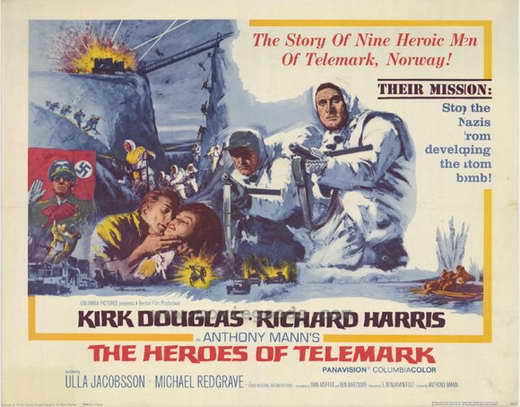
#2,571. The Heroes of Telemark (1965) - Kirk Douglas Film Festival


Anthony Mann directs this large-scale yet strangely lifeless war film, which is based on a true story.

The setting is Nazi-occupied Norway, 1942. Scientist Rolf Pedersen (Kirk Douglas) joins forces with resistance leader Knut Straud (Richard Harris) to sabotage a hydro plant in the small town of Rjukan, which is producing heavy water for the Nazis, a key component in the manufacturing of atomic bombs.

Aided by a small band of fighters, including Pedersen’s ex-wife Anna (Ulla Jacobsson) and her Uncle (Michael Redgrave), they put their plan into motion, knowing full well what it means to rest of the world if they fail.

Mann, who also directed The Fall of the Roman Empire and El-Cid, brings an epic sensibility to The Heroes of Telemark, and there are a handful of big moments scattered throughout the film. Hoping western scientists can shed some light on the Nazis intentions, Pederson, Straud, and a few others hijack a passenger ship and force it to sail to London, resulting in a few tense moments when their boat encounters some mines.

Once word arrives that the Germans do, indeed, intend to build atomic weapons, the decision is made to sabotage the plant, leading to another exciting sequence, while the film’s finale, set aboard a ferry, is positively nerve-racking.

Where The Heroes of Telemark falters is in its characterizations. Douglas and Harris do a fine job as the mismatched freedom fighters: Pedersen takes a more practical approach to the situation, realizing it might be necessary to sacrifice a few innocent civilians for the greater good, while Straud fights tooth and nail for a plan that will spare the lives of his friends and neighbors. Unfortunately, the two never click as a team (there was supposedly friction between Douglas and Harris throughout production, and it shows in their scenes together).

Worse still is the relationship between Pedersen and his ex-wife Anna, which is so woefully underdeveloped that it feels like an afterthought (making the scene where Pedersen crawls into bed with Anna more predatory than romantic).

It may seem a bit nit-picky to complain about poorly developed characters in an action-centric war film, and as I said, the movie boasts a fair number of exciting sequences. But in a story with so much on the line, you can’t completely ignore the human element, and the fact that The Heroes of Telemark comes up as short as it does in that department simply cannot be overlooked.
Rating: 5.5 out of 10


Wednesday, May 19, 2021

#2,570. In Harm's Way (1965) - Kirk Douglas Film Festival


During a 1971 appearance on The Dick Cavett Show, Kirk Douglas took a few moments to discuss fellow actor John Wayne, whom he appeared with in a number of movies. “We have never seen eye-to-eye on a lot of things”, Douglas said, “but… I think he’s one of the most professional actors I’ve ever worked with”. He went on to say how he and Wayne (“Everyone calls him Duke”, Douglas chuckled, “but I’ve always called him John”) never talked politics (a topic on which they were polar opposites), but Kirk admitted “He’s the first guy on the set, he’s the hardest worker I ever worked with, and I think he’s quite a character”.

Both men co-starred in Otto Preminger’s In Harm’s Way, a 1965 black and white WWII epic that manages to sandwich some effective melodrama between its battle sequences.

Wayne is Navy Captain Rockwell “Rock” Torrey. During the attack on Pearl Harbor, Torrey and his executive officer Commander Paul Eddington (Douglas) were out at sea. Both would face disciplinary action in the wake of the attack; Torrey, who was tasked with assembling the remaining fleet and tracking down the enemy, issued an order that resulted in his ship being destroyed by a Japanese sub, while Eddington got into a barroom brawl after learning that his promiscuous wife (Barbara Bouchet) was killed during the attack along with her lover, an Air Force Major (played by Hugh O’Brian).

Torrey and Eddington find themselves on the sidelines as the war in the Pacific escalates, with Rock using his time to romance nurse Maggie Haines (Patricia Neal) and get re-acquainted with his son, Jeremiah (Brandon De Wilde), a Navy ensign whom he hasn’t seen in 18 years (he and Jeremiah’s mother divorced soon after he was born).

Alas, the war is going badly; U.S. forces, under the command of Vice Admiral Broderick (Dana Andrews), have been bogged down, unable to take the island of Levu-Vana from the Japanese. Acting on a recommendation made by Rock’s good friend and fellow officer Cmdr. Egan Powell (Burgess Meredith), the Navy promotes Rock to the rank of Admiral and sends him to the Pacific to head up a fresh offensive.

Taking Eddington along as his second-in-command, Rock successfully captures several key areas, only to discover the Japanese have been sending in heavy reinforcements. With most available troops and equipment tied up elsewhere, Rock, Eddington, and a select few must somehow defeat the Japanese and take Levu-Vana, no matter the cost.

While the battle scenes range from adequate (the final confrontation with the Japanese Navy has its moments) to mediocre (the attack on Pearl Harbor isn’t given much attention, and a few of the sea skirmishes suffer from poor effects), In Harm’s Way proves a very effective wartime drama. Wayne delivers a subdued performance as second-generation Navy man Rock Torrey, and his relationships with Patricia Neal (quite good as the romantic interest) and Brandon De Wilde (as the son who is nothing like his father) are enough to keep us watching until the action picks up again.

Adding a darker element to the story is Douglas’s Eddington, who turns to booze as a way of dealing with his unfaithful wife’s death, then later has a fling with Nurse Annalee Dorne (Jill Haworth), which ends badly (the scene on the beach, where Annalee tells Eddington that she’s engaged to Jeremiah Torrey, is easily the film’s most disturbing moment).

Also strong in support are Burgess Meredith, Dana Andrews, Tom Tryon (as Lt. McConnell, a young Commander who is reported missing in action), Paula Prentiss (as McConnell’s distraught wife), Stanley Holloway (as an Australian who scouts Japanese positions for the Navy), and Patrick O’Neal (as Broderick’s slimy subordinate, who intends to run for office after the war).

In addition to its cast, In Harm’s Way features sparkling cinematography (the work of Loyal Griggs, who was nominated for an Academy Award for his work) and a great score by Jerry Goldsmith.

Wayne (who, a few months after production had wrapped on In Harm’s Way was diagnosed with lung cancer) would become a polarizing force in Hollywood in the years that followed; he won his only Academy Award in 1969 (for True Grit), only to incur the wrath of his peers after an explosive 1971 interview with Playboy magazine (Wayne called Easy Rider and Midnight Cowboyperverted films” and justified the stealing of land from the Native Americans, who were “selfishly trying to keep it for themselves”).

Whatever your opinion might be of John Wayne (and I certainly can’t bring myself to defend his positions or statements, many of which are indefensible), he did manage to shine in the right role, and while Kirk Douglas (like many of us) may not have liked the man, he respected the actor.

Together, these two Hollywood legends helped make In Harm’s Way a truly memorable motion picture.
Rating: 8 out of 10


Monday, May 17, 2021

#2,569. Seven Days in May (1964) - Kirk Douglas Film Festival


Two years after directing The Manchurian Candidate (one of my all-time favorite films), John Frankenheimer again cranked the tension up to 10 with Seven Days in May, a politically-charged thriller with one hell of a cast.

The Cold War is in full swing, but that hasn’t stopped U.S. President Jordan Lyman (Fredric March) from entering into a nuclear disarmament treaty with the Soviet Union. Lyman is convinced it’s the right thing to do, though not everyone agrees. A recent poll revealed that President Lyman’s approval rating is the lowest it has ever been, and the military establishment believes he’s leading the country into a trap, and that the Russians will attack the moment the United States disarms.

The President’s most vocal critic is Air Force General James Mattoon Scott (Burt Lancaster), the chairman of the Joint Chiefs of Staff. As Lyman’s popularity plummets, Scott’s skyrockets, and there are those in both the Senate and the press who believe the General should be the one calling the shots.

While going about his duties as the director of the Joints' Staff, Colonel “Jiggs” Casey (Kirk Douglas) stumbles upon classified information that seems to suggest General Scott and a few others are planning to oust President Lyman and take control of the government. A staunch supporter of General Scott’s, Casey nonetheless feels it is his duty to prevent this coup, and though he has no direct evidence, alerts President Lyman of his suspicions.

With only seven days before Scott’s alleged plan is put into motion, the President and his allies, including White House Chief of Staff Paul Girard (Martin Balsam), Treasury Secretary Chris Todd (George MacReady), and Senator Ray Clark (Edmond O’Brien), move quickly, gathering evidence to expose Scott and prevent his intended coup.

The opening sequence of Seven Days in May, a clash in front of the White House between picketers who oppose the treaty and others who support it, gets the movie off to a nerve-racking start, and from there on out it never loses an ounce of momentum. As he did with The Manchurian Candidate, Frankenheimer brings us to the edge of our seats more than once, especially in the final act, when President Lyman and his team are fighting both the clock and those who are out destroy them.

Lancaster delivers a bravura performance as the egotistical Scott, while Douglas, Balsam, O’Brien (who won a Golden Globe for his turn here), MacReady and Ava Gardner (as a former lover of Scott’s who may just hold the key to exposing the coup) are also strong in their respective roles.

It is Fredric March, however, who damn near steals the show as President Lyman, a man whose political beliefs have made him a target. March is excellent throughout, though his finest moment occurs in the final act, when his President Lyman, still lacking sufficient proof, confronts General Scott. It is an intense exchange, with both actors at the top of their game.

A harrowing, occasionally frightening tale of political conspiracy written by the great Rod Serling, Seven Days in May is as thrilling as they come.
Rating: 9 out of 10


Saturday, May 15, 2021

#2,568. The List of Adrian Messenger (1963) - Kirk Douglas Film Festival


Adrian Messenger (John Merivale) is dead. He was one of over a hundred people who perished when his plane, bound for Canada, exploded in mid-air and crashed into the sea.

A few days before he died, Messenger handed a list of names over to his good friend, former Intelligence Officer Anthony Gethryn (George C. Scott), asking him to track down each person's whereabouts, and if they are still alive.

Messenger never told Gethryn why he wanted this information, and the reasons behind his inquiry would have died with him if it wasn’t for Raoul Le Borg (Jacques Roux), the only survivor of the plane crash and the man who heard Adrian Messenger’s seemingly incoherent last words.

Gethryn is convinced Adrian’s final utterances were, in fact, an attempt to get a message to him, and sure enough, when the pieces fall into place, Gethryn concludes that the plane carrying Adrian Messenger was sabotaged. What’s more, the men whose names are on his list have also died, under mysterious circumstances.

How these men connect to Adrian Messenger, and why anyone would want them all dead, forms the basis of John Huston’s 1963 film The List of Adrian Messenger, a movie that will grab your attention in the very first scene and not let go until the mystery has been solved.

And even then, the filmmakers have one more, very big surprise in store for you!

We know from the first scene that someone is killing the people on Adrian’s list, and before long we even know who the killer is: Kirk Douglas, always in disguise when carrying out his various killings (using make-up to pose as an elderly man, a vicar, and several others, we watch him finish off a handful of victims). Still, we have no idea why his character is committing these murders, and it’s here that the movie distinguishes itself as an exceptionally entertaining mystery.

Scott is remarkable as the ever-inquisitive Gethryn, whose deductive reasoning skills are beyond impressive (though he has very few clues to go on, Gethryn manages to stay one step behind the killer at all times). As for the supporting players, Douglas disappears behind layers of make-up to portray what amounts to a number of different characters, and Roux is strong in the sidekick role (he’s the Dr. Watson to Gethryn’s Sherlock Holmes). Also along for the ride are Dana Wynter as Lady Joselyn Burttenhold, Adrian Messenger’s cousin and a member of a very prestigious family; as well as Herbert Marshall as Sir Wilfred Lucas, Gethryn’s superior.

But it’s the rest of the cast you won’t soon forget, even if you can’t recognize a single one of them. Appearing in cameos throughout The List of Adrian Messenger are Tony Curtis, Burt Lancaster, Robert Mitchum, and Frank Sinatra, all sporting disguises so amazing you'll have no idea which character they played until the very end.

A brilliant mystery that is an incredible amount of fun, I can’t recommend The List of Adrian Messenger enough!
Rating: 9.5 out of 10


Thursday, May 13, 2021

#2,567. Lonely Are The Brave (1962) - Kirk Douglas Film Festival


A westerner likes open country. That means he’s got to hate fences. And the more fences there are, the more he hates them”.

John W. Burns (Kirk Douglas) – Jack for short – is a rare breed. He’s a cowboy in the modern world, living by his own rules... even when they’re at odds with the law. We discover in the opening scene of 1962’s Lonely are the Brave just how much Jack Burns hates fences when he ignores a warning sign, cuts through some barbed wire, hops on his horse “Whiskey”, and rides on through.

After reading in the newspaper that his good friend Paul (Michael Kane) has been arrested for giving aid to illegal immigrants, Jack pays a quick visit to Paul’s wife, Jerry (Gena Rowlands),then heads to a bar, intent on getting himself arrested so that he can break his old buddy out of jail.

Sure enough, Jack has a fight with a one-armed man (Bill Raisch), is hauled to the clink, and reunites with Paul. Using two small hacksaws he hid in his boot, Jack manages to cut through a bar in their jail cell, but Paul refuses to go with him, deciding instead to quietly do his time so that he can get back to his family (if the escape fails, it would result in five years being added to his 24-month sentence).

Once free, Jack heads back to Jerry’s house, jumps on Whiskey, and heads for a nearby mountain range, knowing that if he makes it over those hills, he’ll be a free man.

But the police, led by Sheriff Morey Johnson (Walter Matthau), have no intention of letting Jack Burns slip through their fingers, and with the entire force – as well as an army helicopter - joining in the manhunt, it’s going to take more than a little luck for Jack to escape.

Shot in gorgeous black and white, Lonely are the Brave was written by Dalton Trumbo (based on a novel by Edward Abbey), whose script features plenty of sharp, witty dialogue (though he plays the character straight, Walter Matthau gets his fair share of laughs as the Sheriff) and even the odd action scene (the bar fight is exciting, as is the chase that makes up the film’s final act). 

In addition, there’s the seemingly unrelated tale of a long-distance truck driver (Carroll O’Conner) trying to meet his deadline. Trumbo smoothly weaves this side story into the main narrative, and we know it will somehow - eventually - connect to Jack Burns and his escape, even if we’re not sure how.

Yet as good as all of this is, the best scenes in Lonely Are the Brave feature Jack on the open range, talking with his horse (time and again, we sense the camaraderie between the two, and this proves to be the most poignant relationship in the entire movie). As played by Douglas, Jack Burns is an upbeat, likable guy, a man who enjoys his freedom and will do whatever is necessary to hold onto it. We root like hell for him throughout the movie, and before long even Sheriff Johnson comes to admire the man he’s trying to recapture. The supporting cast – Rowlands, Matthau, Kane, and O’Connor - is also superb, and turning up briefly are both George Kennedy (as a particularly nasty cop) and Bill Bixby (as an Army helicopter pilot).

Kirk Douglas once called Lonely Are the Brave his favorite of all his movies, and it’s easy to see why. Crisply directed (by David Miller), flawlessly written, and expertly acted, Lonely Are the Brave was a perfect storm of creativity.
Rating: 10 out of 10


Tuesday, May 11, 2021

#2,566. Gunfight at the O.K. Corral (1957) - Kirk Douglas Film Festival


The date was October 26, 1881

The time, around 3 p.m.

The place: Tombstone, Arizona.

The Earp brothers and Doc Holliday were on one side, and the “Cowboys” - Ike and Billy Clanton, the McLaury brothers and Billy Claiborne - on the other.

Approximately 30 shots were fired, and the melee is said to have lasted no more than 30 seconds. Yet this showdown, which occurred at a small stable on the outskirts of town, is, to this day, the most famous shoot-out in U.S. history.

It has been immortalized time and again on the silver screen, starting in 1932 (the Walter Huston vehicle Law and Order) and as recently as 2017 (Alex Cox’s Tombstone Rashomon). The most noteworthy films to throw a spotlight on this firefight, however, were directed by John Ford (1946’s My Darling Clementine), George P. Cosmatos (Tombstone, released in 1993), and, of course, the great John Sturges, whose 1957 movie is the only one of the three named after this legendary conflict: Gunfight at the O.K. Corral.

As the movie opens, Marshal Wyatt Earp (Burt Lancaster) and gunslinger / gambler Doc Holliday (Kirk Douglas) are in Fort Griffin, Texas, on opposite sides of the law. Holliday is forced to kill Ed Bailey (Lee Van Cleef), who was looking for revenge (Holliday shot Bailey’s brother, in self-defense). When Holliday is arrested by the sheriff, Wyatt - spurred on by Doc’s girlfriend Kate (Jo Van Fleet) - helps him escape, narrowly avoiding the lynch mob that was forming in the streets below.

From that point on, Wyatt and Doc are friends. Doc settles down in Dodge City, where Wyatt is the law, and even helps Wyatt when Shanghai Pierce (Ted de Corsia) and Johnny Ringo (John Ireland) ride into town.

Wyatt, who has fallen in love with gambler Laura Denbow (Rhonda Fleming), decides to hang up his guns and settle down. That all changes, however, when Wyatt’s brother, Virgil (John Hudson), the sheriff of Tombstone, asks for his help.

It seems Ike Clanton (Lyle Bettger) has been rustling cattle South of the border, and needs to move the herd through Tombstone to take it to market. Wyatt, joined by his other brothers Morgan (DeForest Kelley), and Jimmy (Martin Milner), ride in to help Virgil stop Clanton and his gang, with Doc Holliday tagging along as well, setting the stage for a showdown unlike any the west has ever seen.

Lancaster delivers a strong performance as the straight-laced Wyatt Earp, a lawman who never backs down from a fight. But it’s Douglas’s turn as the ornery Doc Holliday that steals the show. A drunk with a persistent cough (the real Doc Holliday suffered from tuberculosis), we, like Wyatt, are never sure if Doc can be trusted. He is often drunk, and mistreats Kate, so much so that she eventually leaves him and hooks up with Johnny Ringo. Yet, when the chips are down, each man knows that the other has his back, and it’s watching that friendship grow that gives Gunfight at the O.K. Corral its center.

Director Sturges, who in later years would helm The Magnificent Seven and The Great Escape, does a fine job staging the film’s various battle scenes, and the supporting cast, which also features Jack Elam (as Tom McLaury) and a young Dennis Hopper (as Billy Clanton), is excellent. But it’s Lancaster and especially Douglas who helped Gunfight at the O.K. Corral rank alongside The Searchers, High Noon, Rio Bravo, and Winchester ’73 as one of the finest westerns of the 1950s.
Rating: 9.5 out of 10


Friday, May 7, 2021

#2,564. 20,000 Leagues Under the Sea (1954) - Kirk Douglas Film Festival


Produced by Walt Disney, 1954’s 20,000 Leagues Under the Sea is more than a great adventure movie; it’s arguably the finest live-action film that Disney ever released.

The year is 1868, and rumors of a terrible sea monster - a creature large enough to devour an entire ship - have brought trade and commerce in the Pacific region to a standstill. Hoping to get things back on track, the United States government enlists the help of Professor Arronax (Paul Lukas), who, accompanied by his assistant Consell (Peter Lorre) and master harpooner Ned Land (Kirk Douglas), boards a U.S. Navy vessel and sets sail, all in the hopes of tracking down the elusive monster.

They do, indeed, have a run-in with the creature, which sinks their ship and sends Arronax, Consell, and Ned scrambling for the nearest lifeboat. While drifting at sea, though, the trio discovers that the “monster” is, in fact, the Nautilus, a submarine commanded by the nefarious Captain Nemo (James Mason).

Having escaped a penal colony on the island of Rura Penthe, Nemo and his crew (also former prisoners) now roam the Pacific, attacking and sinking every military or trade vessel they encounter. With Arronax and the others as his “guests”, Nemo continues to lash out at the world, while Arronax tries to convince the mad Captain that violence isn’t the answer.

Across the board, the cast assembled for 20,000 Leagues Under the Sea is strong (Kirk Douglas even gets a chance to sing, belting out the incredibly catchy tune “A Whale of a Tale”). Yet the standout performance is delivered by James Mason as the charismatic Nemo, who, despite playing the villain, is at times a sympathetic character (we may not agree with Nemo’s methods, but we understand his motivations).

That said, the real stars of 20,000 Leagues Under the Sea are its set pieces and the wonderfully choreographed adventure scenes. The interior of the Nautilus is breathtaking, as is the design of the sub itself (which, from a distance, looks very much like a sea monster). As for the more exciting moments, the best are the various underwater sequences (in one, Ned and Consell stumble upon a treasure chest, only to be chased by a shark) as well as the movie’s most famous scene: the fight with the giant squid, which has attached itself to the Nautilus and refuses to let go (set during a raging storm, this battle will have you on the edge of your seat).

Over the years, a number of fine movies have been based on the writings of Jules Verne, from the Academy Award-winning Around the World in 80 Days to 1961’s Mysterious Island (which featured special effects by Ray Harryhausen). Towering above them all is 20,000 Leagues Under the Sea, one of the most timelessly entertaining movies that Disney ever released.
Rating: 9.5 out of 10


Monday, May 3, 2021

#2,562. Young Man with a Horn (1950) - Kirk Douglas Film Festival


Based on a 1938 novel of the same name (which was itself inspired by the life of jazz musician Bix Beiderbecke), Young Man with a Horn stars Kirk Douglas as Rick Martin, a gifted trumpet player whose passion for music is all-consuming.

Taught how to play by Jazz trumpeter Art Hazzard (Juano Hernandez), Martin rose from obscurity to become one of the best musicians of his generation, and along with his good pal Smoke Willoughby (Hoagy Carmichael) played dance halls, jazz clubs, and everywhere in between.

The women in Rick’s life, including singer Jo Jordan (Doris Day) and psychiatrist Amy North (Lauren Bacall) - the latter of whom would become his wife - realized early on that Rick Martin’s real love was his trumpet. But when life took a turn for the worse, he found that not even music could see him through the dark times.

By the time he made this 1950 musical / drama, Michael Curtiz had directed around 150 movies, some of which (Casablanca, The Adventures of Robin Hood, Mildred Pierce) still rank among the finest ever made. True to form, he does a remarkable job staging Young Man with a Horn's various musical numbers, giving them a vitality that is tangible; even a late funeral sequence, which features gospel standards like “Swing Low Sweet Chariot”, has energy to spare.

As for the cast, Douglas delivers a top-notch performance as the always-optimistic Martin, a guy who cares more about the music than he does making money, while Doris Day (who also gets to sing a few songs), Carmichael (who doubles as the film’s narrator), and Hernandez shine as Martin’s down-to-earth friends, all of whom try to convince him there’s more to life than his trumpet.

Then there’s Lauren Bacall as Amy, Martin’s eventual wife. Supported by her rich yet estranged father, Amy has failed at everything she’s ever attempted - from playing the piano to getting her college degree - and is envious of Rick’s talent, which has carried him to the top of his profession. It’s a toxic relationship from the start, and Bacall manages to bring a little humanity to what is easily the film's most unlikable character.

With great tunes (band leader Harry James served as the musical advisor and doubled for Douglas’ trumpet playing), an excellent cast, and an old pro like Curtiz at the helm, Young Man with a Horn rises above the standard musical drama to deliver something much more substantial.
Rating: 8 out of 10


Saturday, May 1, 2021

#2,561. Champion (1949) - Kirk Douglas Film Festival


It wasn’t until 1996 that Kirk Douglas finally got his hands on an Oscar statuette, and even then it was only honorary (for his “50 years as a creative and moral force in the motion picture community”).

Prior to that, he had been nominated on three separate occasions for Best Actor, the first of which was for his portrayal of boxing champion Midge Kelly in 1949’s Champion (he was later nominated for The Bad and the Beautiful and Lust for Life). Directed by Mark Robson, Champion is a gritty drama / film noir about a fiercely independent fighter who is often his own worst enemy.

Clawing their way up from skid row, Midge and his kid brother Connie (Arthur Kennedy) bounce around from job to job until Midge finally takes the advice of boxing manager Tommy Haley (Paul Stewart), who, after seeing him stand in for an injured fighter, felt he had the potential to be a great boxer. Dedicating his every waking moment to the sport, Midge wins fight after fight, eventually earning a New York title bout against current champ Johnny Dunne (John Daheim).

But the gamblers, who have heavy money on Dunne to win, order Midge to take a dive. Tired of waiting for his shot, Midge pulls a double-cross and instead knocks Dunne out in the first round.

From that point on, Midge Kelly is unstoppable. He becomes champion of the world, aligning himself with shady characters like Grace (Marilyn Maxwell) and promoter Harris (Luis van Rooten) while at the same time turning his back on his real friends. Through it all, Midge continues to win, but how long will he stay on top?

Douglas gives a searing performance as Midge Kelly, a boxer with a chip on his shoulder who won’t play the patsy for anyone, even when it’s in his best interest to do so; after defeating Dunne in the championship bout, the gamblers beat up not only Midge, but Tommy and Connie as well.

He’s also less that scrupulous when it comes to the ladies. Before deciding to take up the sport that would make him famous, Midge and Connie waited tables and washed dishes at a small beachside café. While there, Midge fell in love with co-worker Emma (Ruth Roman), whose father was their boss. Fearing the romance would disgrace his family, Emma’s dad forced Midge at gunpoint to marry Emma, but after the wedding, Midge and Connie took off for greener pastures, leaving Emma alone to deal with her broken heart. It was the first of several hearts Midge would break as the story unfolds (he even has an affair with Harris’s wife, Palmer - played by Lola Albright - that ends just as badly).

The supporting cast is solid. Kennedy is quite likable as Connie, the kid brother with a bum leg, as is Stewart as the father figure who teaches Midge the ins and outs of boxing. In addition, director Robson does a fine job staging the film’s many fight scenes (especially the climactic bout, a rematch between Midge and Johnny Dunne).

But Champion belongs to Kirk Douglas, whose Midge Kelly is hero and anti-hero at the same time. Even when we don’t like Midge, we root for him, and only an actor of Kirk Douglas’s stature could win over an audience that knows his character is a louse.
Rating: 9 out of 10


Tuesday, July 11, 2017

#2,382. Last Train from Gun Hill (1959) - Kirk Douglas Film Festival


Directed By: John Sturges

Starring: Kirk Douglas, Anthony Quinn, Carolyn Jones


Tagline: "The mightiest double-barreled excitement to blaze across the screen !"

Trivia: Hal B. Wallis bought Les Crutchfield 's story in March 1954 and planned it as a possible starring vehicle for Charlton Heston or Burt Lancaster


Last Train From Gun Hill, a 1959 western directed by John Sturges, gets off to a brutal start; a Native American woman (Ziva Rodann) and a young boy, presumably her son (Lars Henderson), are enjoying a leisurely ride in a horse-drawn wagon when they pass a couple of cowboys resting by the side of the road. 

Looking to have some fun with the pretty squaw, the two cowboys hop on their horses and, after catching up to the wagon, try to convince the woman to slow down. Instead, she hits one of them with her riding whip, leaving a gash on the man’s cheek.

The wagon speeds up, only to capsize when it tries to make a sharp turn. The injured man, none too pleased about the wound he just received, dismounts his horse and corners the squaw, who tells her son to run away as fast as he can. The cowboy rips her top off, and she lets out a scream. Frightened, the woman’s son jumps on one of the assailant’s horses and rides for help, which, unfortunately, won’t arrive in time to save his mother.

But this was no ordinary woman. She was the wife of Matt Morgan (Kirk Douglas), a federal marshal stationed in nearby Pawley. And her attacker was no everyday cowboy. His name is Rick Belden (Earl Holliman), the only son of cattle baron Craig Belden (Anthony Quinn), a man so powerful that he practically owns the town of Gun Hill. To complicate matters, Matt Morgan and Craig Belden are the best of friends, former partners who spent many years riding together before going their separate ways.

To bring his wife’s killers to justice, Morgan hops the next train to Gun Hill, and during the trip meets former saloon girl Linda (Carolyn Jones), who, it turns out, is also close to Craig Belden (though, as we will soon discover, she’s no fan of his son Rick).

Once in Gun Hill, Morgan visits the Belden Ranch, and tells his old pal that he’s going to arrest both Rick and the cowpoke who accompanied him to Pawley, a ranch hand named Lee Smithers (played by Brian G. Hutton) who is himself employed by Craig Belden. Morgan intends to bring the two back to Pawley to stand trial for rape and murder. 

Despite their friendship, Craig Belden warns Morgan not to take his son away, promising that, if he does, all of Gun Hill will stand against him.

With 6 hours to go before the train back to Pawley arrives, it looks as if there’s going to be quite a showdown on the streets of Gun Hill, and seeing as the sheriff (Walter Sande) is in Craig Belden’s pocket, Matt Morgan will have to fight this particular battle alone.

The theme of a hero (or heroes) facing insurmountable odds is one that director John Sturges has returned to time and again throughout his career, whether it be in a western (Bad Day at Black Rock, The Magnificent Seven), a war film (The Great Escape), or a drama (The Old Man and the Sea). In Last Train from Gun Hill, Matt Morgan finds himself taking on not just his friend and the men he employs, but everyone in Gun Hill. Once the reason for his coming to town is made known, Morgan can’t walk down the street without drawing stares from every front porch and window, and the sheriff of Gun Hill refuses to sign his warrants or provide Morgan with deputies to help him serve them. “Isn’t there anyone in this town not afraid of Craig Belden?” Morgan asks the local bartender (Val Avery). “Sure”, the bartender replies. “The graveyard’s full of them”. Morgan does eventually take Rick Belden into custody, resulting in a final act that is as intense as they come.

Yet what makes the showdown in Last Train from Gun Hill so intriguing is that its two major combatants are old chums, and, despite being on opposite sides of this fight, neither man really wants to hurt the other. Though desperate to save his son, Craig Belden gives Morgan several chances to leave town quietly, a courtesy he doesn’t extend to many people (as witnessed earlier when he handed Lee Smithers his walking papers). 

As for Morgan, the anger he feels towards Rick Belden is tempered - at least in part - by the respect he has for Craig. Douglas and Quinn are superb in their respective roles, and by way of their performances we can tell that their characters are damn near heartbroken to be facing off against one another.

But with so much on the line, neither is going to back down, and it’s because of this that Last Train from Gun Hill is as much a tragedy as it is a western.


Tuesday, June 27, 2017

#2,373. Saturn 3 (1980) - Kirk Douglas Film Festival


Directed By: Stanley Donen

Starring: Farrah Fawcett, Kirk Douglas, Harvey Keitel


Tagline: "The Ultimate Space Adventure"

Trivia: The robot Hector stood over eight feet tall and cost a little over a million dollars to make


The critics were especially harsh on Saturn 3, a 1980 sci-fi / horror film directed by Stanley Donen. Roger Ebert called the movie “dumb, dumb, dumb”, while TV Guide declared it “dreadful”. Time Out went so far as to say “there’s more fun to be had cleaning out your cat litter tray”.

Saturn 3 was even nominated for three 1981 Golden Raspberry Awards, for Worst Actor, Worst Actress, and the biggie, Worst Picture (which it lost to Can’t Stop the Music).

But is Saturn 3 really as bad as all that?

Well, it’s no sci-fi classic, but it’s certainly better than the reviews would lead you to believe.

The Earth is overpopulated, and to generate enough food for its inhabitants, research stations have been established on planets and moons all across the solar system. The Saturn 3 food research facility (named as such because it’s situated on Saturn’s third moon) is manned by a two-person crew: Major Adam (Kirk Douglas) and his gorgeous assistant Alex (Farrah Fawcett). They have spent years living in isolation, alone in this vast outpost (in fact, Alex, who was born in space, has never once visited earth). 

In an effort to speed up their production, mission control decides to send a scientist to Saturn 3, who will construct a high-tech robot designed to increase the station’s output. But the person they’ve chosen for the job is murdered just before take-off, and his killer, Captain Benson (Harvey Keitel), disguises himself as the dead man and takes his place. 

Labeled unfit for duty by his superiors, the mentally disturbed Benson nonetheless makes his way to Saturn 3, where, upon his arrival, he falls instantly in love with Alex, who is already romantically involved with Adam. 

Benson does eventually complete his task, building an 8-foot-tall automaton named Hector that is outfitted with human brain tissue (to help it perform more efficiently). But to complete its programming, Hector was required to read Benson’s thoughts, which means this incredibly powerful robot now has the mind of a killer. 

To make matters worse, Hector also inherited Benson’s feelings for Alex, resulting in a showdown between man and machine that threatens to tear Saturn 3 apart.

Perhaps the biggest injustice done to Saturn 3 was Kirk Douglas’s Razzie nomination as the year’s worst actor; his performance as Adam may not be as strong as his work in The Bad and the Beautiful or Paths of Glory, but he’s good enough, and for a man of 62 he was in damn fine physical shape (he even has a nude scene, displaying his bare ass during a skirmish with Benson). 

I also liked Harvey Keitel as Benson, a cold, calculating "scientist" who is the polar opposite of the friendly, outgoing Adam (unfortunately, due to his Brooklyn accent, Keitel’s entire performance was dubbed by actor Roy Dotrice, and to see Harvey Keitel but not hear him was a distraction). 

In addition, the special effects produced for Saturn 3 are good, and the set pieces that make up the space station (designed by John Barry) are better; the facility looks great, and is even quite menacing at times (not as claustrophobic or intimidating as the Nostromo in Alien, but not far off, either). 

Alas, the film has its issues as well, starting with Farrah Fawcett, who, though beautiful, delivers a sub-par performance as Alex. The movie also could have used a bit more backstory (we learn very little about the main characters, and even less about their motivations). Worst of all, though. is the lackluster game of cat-and-mouse that develops between the human characters and Hector the robot (it isn’t nearly as engaging as it should have been, and seeing as it takes up the final third of Saturn 3, this is a pretty big problem).

So while its detractors may have gone a bit overboard in damning Saturn 3, it is far from perfect. Still, I’m glad I saw it, and perhaps, at some point in the future, I may even watch it again.


Friday, September 30, 2011

#420. The Vikings (1958) - Kirk Douglas Film Festival


Directed By: Richard Fleischer

Starring: Kirk Douglas, Tony Curtis, Ernest Borgnine


Tag line: "Mightiest Of Men... Mightiest Of Spectacles... Mightiest Of Motion Pictures!"

Trivia:  Ernest Borgnine plays the father of Kirk Douglas. In real life Borgnine is one and a half months younger than Douglas.


Despite the fact he was a month younger than Kirk Douglas, Ernest Borgnine played his father in Richard Fleischer’s 1958 action epic, The Vikings

As unusual as this might sound, it proved a stroke of casting genius. Borgnine is entirely convincing in the role of Viking Chieftain Ragnar, swaggering through The Vikings with both a marauder’s stature and a penchant for bloodshed, traits he shares with just about every other character in this exciting, entertaining film. 

Set in the Dark Ages, when raiders from the North were terrorizing all of Europe, The Vikings weaves a tale of two men who have more in common than they realize. 

Einar (Kirk Douglas), a Viking prince, has captured Morgana (Janet Leigh), a Welsh Princess betrothed to be married to the English King, Aella (Frank Thring). Over time, Einar becomes infatuated with Morgana, and makes his own plans to marry her. But she, in turn, has fallen in love with Eric (Tony Curtis), a hot-blooded slave who has made an enemy of Einar, insulting the Prince on several occasions. 

What neither Eric nor Einar realize is that they are half-brothers, each the son of the Viking chieftain Ragnar (Borgnine). Driven by their mutual love for Morgana and a deep hatred for one another, Eric and Einar prepare for their inevitable showdown, and to the victor will go the spoils. 

The ultimate goal of director Fleischer and star Kirk Douglas (who also served as the film’s producer) was to make The Vikings as realistic a motion picture as possible. Portions of the movie were shot on location in the Fjords of Norway, and Fleischer spent a considerable amount of time at a Viking museum in Oslo, researching - among other things - the design of the magnificent ships that appear throughout the film. 

But this realism would extend beyond mere settings and props, influencing the movie's characters as well. As Einar, Kirk Douglas is splendidly arrogant and physically intimidating, a Viking warrior in every respect; drinking heavily, carousing with women, and living for the thrill of battle. It is Einar who leads the expedition to capture Morgana, and upon boarding her ship shows no mercy whatsoever, slaughtering the Princess’s escorts in quick and brutal fashion. Once triumphant, Einar brags that he’s decided to keep Morgana as his own, ignoring his father’s wishes that a ransom be demanded from the English King for her safe return. 

The role of Einar was certainly not a glamorous one, nor was it very sympathetic, yet Douglas delivers a performance that is bursting with gusto and personality. This, coupled with the movie’s painstakingly accurate portrayal of a Viking society, succeeds in carrying us back to the Dark Ages, which, if The Vikings is to be believed, was a grim, brutal period of mankind's history.