
To prove to the New York mob that he still has clout, Parisian millionaire Phillipe Douvier (Robert Webber, not even attempting a French accent), who is also head of the drug cartel known as the “French Connection”, decides to assassinate the city’s most decorated law enforcement official: Chief Inspector Jacques Clouseau (Sellers). Of course, as we’ve seen time and again, killing someone as imbecilic as Clouseau is no easy task. But Douvier’s henchmen manage to pull it off, shooting Clouseau dead in his car, which then slams into a tree and explodes on impact.
All of France mourns the loss of a true hero, but what nobody realizes is that Douvier’s assassins killed the wrong person! Just before the shooting, Clouseau was held up at gunpoint by cross-dressing criminal Claude Russo (Sue Lloyd), who forced the inspector to swap clothes with him, then drove off in his car. With Russo dead but the world thinking it was him, Clouseau goes undercover and, with the help of his trusty manservant Cato (Burt Kwouk) and Douvier’s jilted mistress Simone (Dyan Cannon), flies to Hong Kong to stop a major drug deal and arrest Douvier.
Anyone familiar with the Pink Panther series will know what to expect from Revenge of the Pink Panther. Early in the movie, Clouseau visits the shop of his disguise maker, Professor Auguste Balls (Graham Stark), and you can just imagine the double-entendres that pop up every time this character’s name is mentioned! There is also yet another hilarious showdown between Clouseau and Cato, who is under strict orders to attack his boss every time he comes home (what the two don’t know is that one of Douvier’s hired killers, a Kung Fu expert played by Ed Parker, is also in the apartment). And while I think the previous entry in the series, The Pink Panther Strikes Again, had more laughs, I give Revenge of the Pink Panther credit for having a somewhat cohesive story, which was lacking in its predecessor.
Also back is Herbert Lom as former Chief Inspector Dreyfus, once again confined to an insane asylum. Despite transforming into an evil genius in The Pink Panther Strikes Again and attempting to destroy the world, Dreyfus is not only given a full release from the asylum but also restored to his previous rank of Chief Inspector!
Only in a Pink Panther movie.
Once back on the force, Dreyfus’s first assignment is to track down Clouseau’s killers. While he may secretly rejoice over the death of his nemesis, he does take the job seriously, even if it’s hard for him to hold back his elation. In what is my favorite scene of the movie, Dreyfus is ordered to deliver Clouseau’s eulogy (which was written by the Commissioner’s wife), with the mourners mistaking his stifled laughter each time he praises Clouseau for tears.
I’m not a fan of the grand finale of Revenge of the Pink Panther, a slapstick-riddled chase through the streets of Hong Kong, and the continuous racial slurs directed at Cato, not to mention the fact that Sellers (and other Caucasians) occasionally appear in Asian make-up, don’t play as well today as they might have in 1978. That said, I did laugh, and often, over the course of the movie. As a Pink Panther film, this was a decent swan song for Sellers.
Rating: 7 out of 10

But The Pink Panther Strikes Again is also a mess. Its story is incohesive and bounces all over the place, from one subplot to the next, with no rhyme or reason. At times it feels more like a series of vignettes with a common theme than it does a feature film.
Rest assured, however, that these “vignettes” will have you rolling on the floor.
It has been three years since Chief Inspector Dreyfus (Herbert Lom) was committed to an asylum for the criminally insane. His former colleague – and the reason he lost his mind in the first place – Jacques Clouseau (Sellers) has since taken over as Chief Inspector of the Sûreté.
Given a clean bill of health by his doctors, Dreyfus was about to be set free. That is, until Clouseau came to visit him, an encounter that caused enough injury, and stirred up enough mayhem, to “break” Dreyfus once again. His hopes of a pardon dashed, Dreyfus escapes from the asylum, more determined than ever to kill Clouseau.
To this end, the former Chief Inspector:
1. Recruits the world’s most notorious criminals
2. Stages a daring bank robbery, and
3. Kidnaps renowned British physicist Hugo Fassbender (Richard Vernon) and his daughter (Briony McRoberts).
His plan: force Fassbender to build him a Doomsday machine, a laser so powerful it can wipe out an entire continent.
Once the weapon is completed, Dreyfus demonstrates its power by making the U.N. Building in New York vanish without a trace, then issues his demands to the world: turn Clouseau over within seven days, or he will destroy an entire city!
As for Clouseau, he is on the case, first teaming up with Scotland Yard to track down the kidnappers that abducted the Fassbenders, then setting his sights on finding Dreyfus’s secret hideout. But even if the blundering Clouseau does crack the case, odds are he will, in the process, do even more damage than the Doomsday Machine!
The Pink Panther Strikes Again gets off to a brilliant start with an hilarious pre-title sequence, during which a calm, sane Dreyfus is reduced to a quivering mass of nerves after spending just five minutes with Clouseau. There are other great moments as well, such as Clouseau returning home for the evening and getting into an epic battle with his servant Kato, not realizing that the escaped Dreyfus is in the apartment below, plotting to blow him to smithereens (a recurring gag involving Dreyfus drilling holes and watching Clouseau with a handheld periscope had my sides splitting).
But wait, there’s more.
Sellers is near flawless in the scene where Clouseau is questioning the household staff at the Fassbender Estate; and later, he takes a trip to Oktoberfest, where assassins from at least a dozen countries are trying to eliminate him (there’s a moment in a bathroom stall that is comedic gold).
Still, as good as Sellers is, one of the best things about The Pink Panther Strikes Again is that it gives Herbert Lom more screen time than he had in any of the previous movies, and his “lunatic Dreyfus” gets his share of laughs as well. The scene where he “tortures” Fassbender’s daughter is arguably one of the film’s most memorable.
There’s even a handful of amusing sequences set inside the White House, with President Gerald Ford (Dick Crockett), Henry Kissinger (Byron Kane), and the rest of the cabinet discussing how best to deal with the terror that Dreyfus has unleashed on the world.
Along with the comedy, The Pink Panther Strikes Again has a daring jailbreak set on a moving train; and a finale so elaborate it would have been at home in any of the James Bond movies.
That’s a lot to cram into one film, but it is still not the half of it, and herein lies the main issue I had with The Pink Panther Strikes Again. It’s just too much!
In addition to everything above, we get a few scenes in a gay bar, where the Fassbender’s butler, Jarvis (Michael Robbins), has a drag act (his singing voice was dubbed by Julie Andrews, Blake Edwards’ wife); as well as sequences set in Scotland Yard, where Superintendent Quinlan (Leonard Rossiter), who suffered an injury due to Clouseau’s incompetence, must decide whether or not to tell Paris their Chief Inspector is a moron.
There is even a poorly developed romance that blossoms between Clouseau and Russian assassin Olga Barlosova (Lesley-Anne Down), who was originally sent to kill him. And on top of all this, Omar Sharif turns up in a cameo… as an Egyptian assassin!
After doing a little research, I found out the film's issues likely developed during the scriptwriting phase. Initially, Blake Edwards and his co-writer Frank Waldman were going to turn Clouseau and The Pink Panther into a TV series. Eventually, that idea was dropped, and the script they had been compiling was turned first into The Return of the Pink Panther, then this movie.
The Return of the Pink Panther was at least somewhat structured, but by the time they got to The Pink Panther Strikes Again, they had to throw everything that was left into it, whether it made sense or not (there is no logical reason Clouseau went to Oktoberfest in the first place).
Apparently, there was even more! The first cut of this movie was three hours long (much of the excised footage would be re-used in the dismal 1982 failure Trail of the Pink Panther, a cheap attempt to keep the series going after Sellers passed away in 1980).
Not that any of this confusion matters in the end. You watch a Pink Panther movie to laugh, and when the chips are down, The Pink Panther Strikes Again works because it is flat-out hilarious.
Rating: 7 out of 10
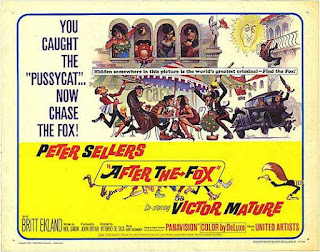
Directed by Vittorio de Sica (Bicycle Thieves, The Children are Watching Us).
Starring Peter Sellers (Dr. Strangelove, The Pink Panther).
Now, that’s a hell of a pedigree for any movie! And After the Fox is a hell of a movie. Not perfect, mind you, but with a manic energy that is infectious, and a story that’s just madcap enough to keep you laughing.
Master criminal Aldo Vanucci (Sellers), whose nickname is “The Fox”, has escaped from an Italian prison. After stopping home for a quick reunion with his bitter mother (Lydia Brazzi) and younger sister Gina (Britt Ekland), Vanucci goes into hiding, during which time he is contacted by fellow crook Okra (Akim Tamiroff).
Okra recently masterminded the theft of hundreds of gold bars in Cairo, and promises Vanucci half the loot if he can figure out a way to get that gold into Italy.
So, Vanucci devises an ingenious scheme. Posing as a film director named Federico Fabrizi, Vanucci will make a “movie” about a fortune in gold being smuggled into the country! He even manages to cast American star Tony Powell (Victor Mature) as the lead, much to the chagrin of Powell’s longtime manager Harry (Martin Balsam).
Aided by his gang, and with Powell in tow, Vanucci heads to the small seaside village of Sevalio, where the gold will be brought ashore. A fast talker, Vanucci convinces all of the locals, including the chief of police (Lando Buzzanco), to appear as extras.
With so many people helping, getting the gold loaded onto a truck will be a piece of cake. But two detectives (Tiberio Murgia and Francesco De Leone) are hot on his trail, meaning Vanucci will have to work fast if he is to have any chance of pulling off his elaborate scheme.
Having scored hits on Broadway with Barefoot in the Park and The Odd Couple, After the Fox was Neil Simon’s first original screenplay, and features much of his patented wit. But the movie is more a showcase for Peter Sellers’ unique brand of comedy than it is Simon’s. The first half of the film, which features Vanucci’s escape from prison and his attempts to suppress the movie star aspirations of his pretty sister, are funny enough. But it is the later scenes, where the character is in full “director” mode, that the actor’s talents shine brightest.
At one point, everyone in town is on the beach, waiting for the gold to arrive so they can shoot the “big finale”. Unfortunately, Okra learns the boat is running late, which means Fabrizi / Vanucci has to stall. With no idea what to do, he “shoots” an impromptu scene with Powell and Gina (who is posing as the film’s starlet) sitting at a dinner table, which has been hastily set up in the sand. When Powell asks what he and Gina are supposed to do in this scene, Vanucci says “do… nothing”. So, the two stare at one another.
Fabrizi follows this up by having them do “something”: he orders Powell and Gina to run through the entire town. When Powell asks who they’re running from, Vanucci replies “yourselves”. All at once, everyone witnessing these exchanges, Powell included, are convinced Fabrizi is an arthouse genius!
Also great is the film’s opening song, written by Burt Bacharach and Hal David (who scored a hit the year earlier with the title track for What’s New Pussycat) and featuring a duet between Peter Sellers and the rock group The Hollies!
A funny movie that takes potshots at egotistical directors (De Sica makes a cameo as himself, shooting a biblical picture in Egypt and telling his assistants the desert needs “more sand”), extreme fandom (Powell is mobbed by adoring fans everywhere he goes), and film snobs (there’s a late scene involving a movie critic that is hilarious), After the Fox is a ‘60s heist film and spoof of the cinema rolled into one. And despite a few slow spots in the middle, it does a damn good job with both.
Rating: 8.5 out of 10
Y
ears before taking on three roles in Stanley Kubrick’s Dr. Strangelove, Peter Sellers played a trio of characters in The Mouse That Roared, a 1959 comedy about a tiny country that declares war on the United States, and damn near comes out on top!
The Duchy of Grand Fenwick, an English-speaking dot on the map situated in the French Alps, has one chief export: wine! It seems their wine is a big hit in the United States, and this has kept the Duchy’s economy afloat for years. But when a vineyard in California knocks off their recipe, then charges less per bottle, Grand Fenwick finds themselves facing financial ruin.
In an effort to save his country, Prime Minister Count Rupert Mountjoy (Sellers) hatches a crazy scheme: declare war on the United States! Duchess Gloriana XII (also Sellers), the ruler of Grand Fenwick, and Benter (Leo McKern), leader of the opposition, have serious reservations, noting they do not have a prayer of winning such a war.
To their surprise, Count Mountjoy agrees with them. What’s more, he’s hoping they lose!
Familiar with U.S. history, Mountjoy believes that, once they are defeated, the United States will flood Grand Fenwick with millions of dollars in war reparations, at which point they will not only have secured their financial independence, but might also be able to afford that new coffee maker they have had their eye on!
Soon after mailing off their declaration to the U.S., Game Warden Tully Bascombe (Sellers, yet again) is named Field Marshall of the Grand Fenwick military, which consists of his second-in-command, Sergeant Will Buckley (William Hartnell), and twenty troops armed with bows and arrows. Boarding a small French steamer heading to New York, Tully and his platoon start their “invasion”, intent on surrendering the moment they hit U.S. soil.
Alas, things do not go according to plan. The day they arrive, New York is in the midst of a city-wide air raid drill, which means the streets are deserted. Then, while looking for a military H.Q., Tully and his men instead stumble upon Dr. Alfred Kokintz (David Kossoff) and his daughter Helen (Jean Seberg). Dr. Kokintz is the reason the city is practicing for an air raid, due to the fact he has just created the dreaded Q-Bomb, an atomic device powerful enough to destroy an entire continent!
Not only does Tully take the Dr. and his daughter prisoner, but he also confiscates the Q-bomb and, in the process, even captures a U.S. General (MacDonald Parke) and four New York policemen, taking all of them back to Grand Fenwick as his prisoners.
Their plan a shambles, Mountjoy and the others must scramble to get themselves out of this mess, and hopefully do so before the dreaded Q-bomb, which is highly volatile, explodes and takes all of Europe with it!
Directed by Jack Arnold and based on Leonard Wibberley’s novel of the same name, The Mouse That Roared is a very funny movie. The scenes in which Tully and his men are walking through the streets of an abandoned New York, wearing chain mail and carrying bows, is quite a sight. But it is when the “invasion” goes awry, and Tully returns a conquering hero, that things really spiral out of control. To get their greedy mitts on Kokintz’s Q-Bomb, practically every other country in the world lines up to support Grand Fenwick in their war against the United States, a war that Mountjoy and the others had hoped would be over already! There is also a romantic subplot, with Tully falling in love with Helen, whose initial annoyance at being taken prisoner eventually gives way to genuine affection.
Sellers, as expected, is quite good in all three roles. He is likable as the nebbish Tully, who makes a complete mess of things by winning the war; and even gets to camp it up a bit as the elderly Duchess. That said, it’s Sellers’s turn as Mountjoy that is his best, playing a devilishly clever character who is equally as conniving.
Yet as impressive as Sellers is, The Mouse That Roared would have been just as funny had another, or even three other actors, played his parts. This is a situational comedy, and it is what transpires over the course of the movie that has us laughing. Sure, Sellers is good. He always is. But unlike Dr. Strangelove, where he shines and even steals the film’s later scenes as the title character, it’s the story in The Mouse That Roared, and not Sellers’ patented madcap physical humor, that keeps us in stitches.
Rating: 8.5 out of 10

