Showing posts with label Spotlight on England. Show all posts

Saturday, October 22, 2022

#2,845. Benny Loves You (2019) - Spotlight on England


In an early scene from writer / director Karl Holt’s Benny Loves You, the lead character Jack (played by Holt himself), who still lives at home, is celebrating his 35th birthday with his parents (Catriona McDonald and Greg Page). Unfortunately, mom and dad have a little… accident. Actually, it’s not so little; when Jack finds them, Dad is lying dead on the floor and Mom, her entire face impaled on toothpicks, is about to draw her final breath.

Played for laughs, this is nonetheless a gruesome scene, but by the time the movie is over, we’ll realize mom and dad got off easy! Filled to its breaking point with blood, guts, and gore, Benny Loves You is as gross as it is funny.

Ten months after his parents’ demise, Jack, a talentless toy designer, is on the verge of losing both his house and his job. His humorless boss Ron (James Parsons) demotes him, cutting his salary by 33%, and the rep with his bank (Greg Barnett) tries to “help” Jack… by demanding he pay four times his usual amount to catch up, or risk foreclosure on his childhood home.

Determined to finally grow up and take control of his life, Jack throws away all of his old toys, including his beloved stuffed animal Benny, who has been his best friend since he was a kid.

But Benny isn’t going to take this lying down. In an amazing turn of events, the stuffed creature springs to life, and starts tormenting Jack night and day. What’s more, Benny is determined to kill anyone who stands between him and his “best pal”, usually in as grisly a fashion as possible!

A goofy but oh-so-fun horror / comedy, Benny Loves You will have you howling at Benny’s antics. Repeating “Benny loves you” over and over, the foot-and-a-half tall stuffed toy brings the pain, butchering his victims in a manner that would impress Jason Voorhees. David, the bank rep, is the first to incite Benny’s wrath, and when the smoke clears, Jack has to dispose of entrails and a severed head before mopping up gallons of blood.

Yet as violent as Benny can be, watching him bounce around the house, a smile plastered on his face, will have you in stitches. In fact, Benny, despite being a homicidal maniac, is arguably the film’s most endearing character! With its story of abandoned toys getting their revenge on the owners that discard then, Benny Loves You gets crazier by the minute, and it’s the film’s human characters - Jack included – who feel more like caricatures than real people. Jack’s arch-nemesis at work, the kiss-ass Richard (George Collie), is an insufferable prick throughout the movie, and two policemen investigating the rash of recent disappearances aren’t even given names; they’re simply listed in the credits as “Good Cop” (Darren Benedict) and “Bad Cop” (Anthony Styles).

If you’re a fan of gore and don’t mind comedy with your horror (and in this movie, the comedy takes center stage), then Benny Loves You is sure to bring a smile to your face.
Rating: 8 out of 10


Thursday, October 13, 2022

#2,836. Rawhead Rex (1986) - Spotlight on England


Clive Barker, who wrote the screenplay for 1986’s Rawhead Rex, is not a fan of the movie. “Adaptations like Rawhead Rex were deeply disappointing”, he told Fangoria magazine back in 1992, “because the filmmakers didn't give a shit about the story's underlying psychology - they just wanted to make a monster movie."

To be sure, the veiled themes of sexuality that Barker intended were either glossed over or dropped completely, but as a straight-up “monster movie”, I think Rawhead Rex is exceptionally strong.

While researching his newest book on ancient cultures, writer Howard Hollenbeck (David Dukes) and his family, including wife Elaine (Kelly Piper) and their two young children, spend some time in a small Irish village, where Hollenbeck believes the local church sits on what was once, during the pre-roman era, hallowed ground.

His arrival coincides with the reappearance of a primeval creature, an evil entity that slaughters every man in encounters. When their paths cross, a tragedy occurs, leaving Hollenbeck determined to seek out and destroy this monster – known to the locals as Rawhead Rex – before it has a chance to kill again.

Directed by George Pavlou, Rawhead Rex is a bit confusing at times; without Barker’s intended sexuality (he saw the monster as a large phallic symbol, saying “Basically, I wrote a story about a ten-foot prick which goes on the rampage”), we have no idea why the creature attacks only men, and shrinks away from women (these undertones are implied, but not very clearly), and the final scene, though effective, is downright baffling as a result. Also, the creature itself isn’t the most impressive (played by Heinrich von Schellendorf, it looks every bit like a guy in a suit).

Still, Rawhead Rex features a handful of well-shot attack scenes, occasionally shown in their entirety from the monster’s perspective, and the blood and gore is pretty darn convincing for a low-budget creature feature. I also found the religious subtext quite interesting; Hollenbeck occasionally confers with Reverend Coot, played by Niall Toibin, and faces off against Coot’s subordinate Declan O’Brien (Ronan Wilmott), who has fallen under the monster’s spell (the church’s stained-glass window also helps Hollenbeck decipher what Rawhead Rex is, and where he came from).

Rawhead Rex may not be the best Clive Barker adaptation ever committed to film, but it’s a fun horror movie nonetheless, and I had a good time watching it.
Rating: 7 out of 10


Friday, October 7, 2022

#2,830. Possum (2018) - Spotlight on England


The moment we meet Philip, the lead character of director Matthew Holness’s 2018’s horror film Possum, we know he’s damaged, that a terrible event from his past has shattered his psyche.

Played to perfection by Sean Harris, Philip is a former puppeteer who always carries around a leather handbag, inside of which is a grotesque puppet with giant, spider-like legs and a human head. Philip spends an inordinate amount of time trying to dispose of said puppet, but when he goes to bed at night, thinking he’s rid of it once and for all, he awakens the next morning to find it has inexplicably returned.

Philip lives with his former caretaker Uncle Maurice (Alun Armstrong) in the very house where, years earlier, Philip’s parents died in a fire. Haunted by the traumas of his past, which resurface following a news report about a middle school student who has been kidnapped, Philip struggles to maintain his sanity, which is rapidly slipping away from him.

As already mentioned, Sean Harris is brilliant as the meek, disturbed Philip, whose mind is so warped that we’re never quite sure if what we’re seeing is real, or simply a figment of his imagination. Equally good is Armstrong as the despicable Maurice, whose abusive mannerisms undoubtedly contributed to Philip’s current mental state (on occasion, Philip musters up the courage to stand up to Maurice, but Maurice clearly has the upper hand on him through most of the film).

Complementing the performances is the meticulous, deliberate pace employed by director Holness, who builds a sense of foreboding and dread that gets stronger with each passing scene, and those moments when the hideous puppet seems to come alive are easily the film’s most frightening (it’s a shock each and every time it returns).

As with many recent entries in the horror genre, Possum is in no hurry to reveal its secrets (why is Philip traumatized? Why can’t he rid himself of that puppet? What did he do to become a pariah in his neighborhood?), but with the fine work turned in by cast and crew (including a haunting electronic score composed by The Radiophonic Workshop), I was more than willing to wait for the payoff, and even though said payoff wasn’t exactly a surprise, it proved as satisfying as the journey itself.
Rating: 8.5 out of 10


Saturday, December 11, 2021

#2,675. A Private Function (1984) - Spotlight on England


Michael Palin has always been my favorite Monty Python alum, and both he and co-star Maggie Smith do a wonderful job as the mismatched husband / wife of director Malcolm Mowbray’s 1984 comedy A Private Function.

ut this is far from a two-person movie; it features a supporting cast that’s every bit as impressive as the leads.

Palin and Smith play Gilbert & Joyce Chilvers, an upwardly mobile couple (if Joyce has anything to say about it, that is) in Post-WWII England.

The small Yorkshire town in which they reside has decided to stage a celebration in honor of the Royal Wedding of Princess Elizabeth and Prince Philip. Unfortunately, food rationing restrictions put in place during the war have yet to be lifted, making it difficult to plan a menu for the festive occasion. So, some of the town’s more prestigious residents, including Dr. Charles Swaby (Denholm Elliott) and Accountant Henry Allardyce (Richard Griffiths) decide to thumb their nose at rationing by illegally raising a pig to serve as the main course.

Hoping to improve their standing within the community, Gilbert - following Joyce’s lead - kidnaps the pig from the local butcher (Pete Postlethwaite). Joyce is convinced this theft will force the town to notice them, but are the Chilvers truly prepared to keep such an animal hostage in their modest home?

A Private Function features some very funny moments (especially the scenes in which Gilbert and Joyce try to control the pig they’ve so callously unleashed on their humble abode), and the filmmakers did a fine job recreating the late 1940’s time period.

But it’s the cast that makes this one such a treat. Palin is quite good as the meekly Gilbert, a door-to-door foot doctor whose wife looks down on his profession of choice (“Can we please not bring feet to the table?”, she snaps when Gilbert tries to discuss his day over dinner), whereas Smith is hilariously frantic as the wife who wants nothing more than to be accepted by the town’s upper crust (“It’s not just pork, Gilbert”, she says at one point, “It’s power!”).

As for the supporting players, Denholm Elliott is at his pompous best as the snobbish Dr. Swaby, while Griffiths’ Allardyce eventually finds himself enjoying the pig’s company, looking on it more as a pet than a main course. Also strong are Bill Paterson as an uptight meat inspector who comes snooping around and Liz Smith as Joyce’s mother, who is afraid of being put in a home yet acts more senile with each passing scene.

Written by Alan Bennett (who also penned the screenplay for 1994’s The Madness of King George), A Private Function and its wonderful cast of characters will have you smiling ear-to-ear. If you’re a fan of British comedy, this is one you won’t want to miss.
Rating: 9 out of 10


Thursday, October 14, 2021

#2,637. The Wicker Man (1973) - Spotlight on England


It had been a while since I last watched The Wicker Man, and I’d forgotten how great it is. Combining elements of horror, mystery, even a musical, director Robin Hardy’s film (from a script by Anthony Shaffer) pulls you in with its story before knocking you out with one of the most chilling finales in cinematic history. 

Police officer Howie (Edward Woodward) visits the small Scottish Island of Summerisle to search for a missing girl named Rowan Morrison. 

During his investigation, the devoutly Christian Howie is shocked and appalled to discover that the residents of this small community, led by the charismatic Lord Summerisle (Christopher Lee), live a pagan lifestyle, worshiping sun and water Gods and engaging in all manner of “lewd” behavior. 

What’s more, not a single person on Summerisle, not the Librarian (Ingrid Pitt), the barmaid (Britt Eklund), or the missing girl’s supposed mother (Irene Sunters), claim to have any knowledge of Rowan Morrison, going so far as to say that nobody by that name has ever lived there! 

Woodward is at his absolute best as Howie, a self-righteous officer of the law whose personal beliefs give him the strength to carry on under trying circumstances, and Lee is equally superb as the friendly Lord Summerisle, a man with his own set of values of which he, too, feels strongly. Their scenes together are outstanding, and I enjoyed the film’s musical asides as well, my favorite being the bawdy number in the bar, where the male patrons sing about barmaid Britt Eklund’s promiscuous ways. 

It’s the final act, however, that makes The Wicker Man an unforgettable experience. Most of you know what I’m talking about, but if you haven’t seen the movie, I advise you to go into it cold; don’t watch trailers or read anything that might spoil it. The ending of The Wicker Man is sure to shake you; I knew what was coming this time around, and it shook me all the same!
Rating: 10 out of 10


Saturday, August 21, 2021

#2,603. 1917 (2019) - Spotlight on England


A number of strong films were released in 2019, from Quentin Tarantino’s newest opus Once Upon a Time… in Hollywood to Mike Flanagan’s excellent Doctor Sleep, a sequel to Stanley Kubrick’s The Shining.

But as far as I’m concerned, Sam Mendes’ epic World War One tale 1917 was the movie of the year.

To prevent the slaughter of an entire regiment, Lance Corporals Schofield (George MacKay) and Blake (Dean-Charles Chapman) volunteer to travel across no-mans-land and into enemy territory to deliver a message to Col. MacKenzie: call off the upcoming attack. If the two are successful, they will have saved the lives of some 1,600 men, including Blake’s own brother. If they fail, the regiment will be walking into a trap set by the Germans.

Utilizing long, continuous shots, 1917 puts its audience smack dab in the middle of the action, as if we’re walking alongside Schofield and Blake in real-time as they carry out their mission. It’s a unique approach, pulled off brilliantly by Mendes and his crew, but more than that, this stylistic choice shows us, in no uncertain terms, just how quickly danger can sneak up on an unsuspecting soldier (an early scene in the German trenches involving a rat is the first of many such sequences).

The moment the two leads begin their mission, 1917 moves forward at full-throttle, maintaining a high level of excitement and tension that never lets up. Skillfully executed by everyone involved, from the actors through to the production designers, 1917 is destined to stand alongside Grand Illusion, Gallipoli, and All Quiet on the Western Front as one the greatest WWI films of all-time.
Rating: 10 out of 10


Tuesday, August 17, 2021

#2,601. The Night My Number Came Up (1955) - Spotlight on England


This lesser-known Ealing Studios release plays like an extended episode of The Twilight Zone.

While at a party in Hong Kong, British Naval Commander Lindsey (Michael Horndem) tells some of the other guests, including Air Marshall Hardie (Michael Redgrave), Hardie’s personal assistant McKenzie (Denholm Elliott), and government official Owen Robertson (Alexander Knox), about a dream he had the night before, in which the plane the three men were scheduled to board the next day along with 5 additional passengers crashed off the coast of Japan.

Though they initially laugh it off, Hardie, McKenzie, and Robertson soon find themselves worrying when even the most unlikely details of Lindsey’s dream start coming true.

Supposedly based on a true story (lifted from the personal journal of British Air Marshal Sir Victor Goddard), The Night My Number Came Up is an intriguing supernatural thriller, yet it’s the more dramatic moments, when the passengers on board the plane slowly realize they may be in great danger, where the film truly shines.

Redgrave, Elliott, and Knox deliver top-notch performances, as does Shelia Sim, playing yet another passenger. The script, smartly written by R.C. Sherriff, delves a little into the issue of fate versus free will, and even though we know up-front what’s ultimately going to happen (it’s revealed in the opening scene), the movie nonetheless remains tense throughout.
Rating: 8 out of 10


Sunday, June 11, 2017

#2,367. A Night to Remember (1958) - Spotlight on England


Directed By: Roy Ward Baker

Starring: Kenneth More, Ronald Allen, Robert Ayres


Tag line: "TITANIC... The greatest sea drama in living memory told as it really happened!"

Trivia: This is regarded as the largest British production of the 1950s. It was also the most expensive film made by the Rank Organization


With a budget somewhere in the neighborhood of $200 million, James Cameron’s 1997 award-winning film Titanic recreated, in great detail, the sinking of the RMS Titanic, the British luxury liner that struck an iceberg in April of 1912 and carried some 1,500 souls with it to its watery grave. 

It is a tragedy that continues to fascinate. A mammoth ship, the RMS Titanic was labeled “unsinkable” by its manufacturer, the White Star line. Yet it never completed its maiden voyage, and sits, to this day, at the bottom of the North Atlantic. Packed with drama, romance, and plenty of thrills, 1997’s Titanic took in over a billion dollars worldwide, making it one of the biggest box-office successes in cinematic history.

Directed by Roy Ward Baker, 1958’s A Night to Remember is another take on the Titanic tragedy. It was produced on a more modest budget (estimated to be around half a million British pounds), yet is every bit as realistic, every bit as intense, and every bit as moving as Cameron’s epic undertaking.

While sailing from London to New York, the RMS Titanic, the largest liner ever constructed, sideswipes an iceberg in the North Atlantic. What at first seems like a near-miss soon proves catastrophic when the ship’s designer, Thomas Andrews (Michael Goodliffe), informs the crew that a gash in its side is flooding Titanic’s lower decks, and in a few hours the great vessel will sink to the bottom of the ocean. 

Knowing full well there aren’t enough life boats to save everyone on board, Captain Smith (Laurence Naismith) and his subordinates, including First officer Murdoch (Richard leech) and Second Officer Lightoller (Kenneth More), do what they can to get the women and children to safety, all the while hoping that a nearby ship will come to their rescue. 

Unfortunately, the only vessel to answer Titanic’s distress call is the RMS Carpathia, whose Captain, Arthur Rostron (Anthony Bushell), orders his crew to take whatever steps necessary to get them to Titanic’s position as quickly as possible. Even at full-speed, though, the Carpathia is 4 hours away, meaning a good many will already be dead by the time it arrives.

Based on Walter Lord’s non-fiction book of the same name, A Night to Remember takes its time at the beginning to introduce the various characters, most notably Second Officer Lightoller, played superbly by top-billed star Kenneth More, who spends the days prior to Titanic's maiden voyage in the company of his wife (Jane Downs). That said, the majority of the movie is dedicated to what transpires after the ship hits the iceberg, with events playing out as quickly as they did that fateful night in April, 1912. 

Upper-class passengers, most of whom have no concept of the danger they’re in, complain about the “inconvenience” of putting on life jackets and gathering on the frigid deck. A nearby ship, the Californian (no more than 10 miles away) is oblivious to Titanic’s situation, and ignores the SOS signals, including the distress rockets sent up every five minutes. Then there are the passengers on Titanic's lower decks, locked in until the first and second classes have safely boarded the lifeboats. Those who survived the disaster would praise A Night to Remember for its realism, and it’s to the filmmaker’s credit that they went to such lengths to depict this terrible night as accurately as possible.

But A Night to Remember is more than a documentary-style account; it features plenty of drama as well. After a brief conversation with Thomas Andrews, first-class passenger Robbie Lucas (John Merivale), realizing how dire the situation is, calmly convinces his wife (Honor Blackman) to board one of the lifeboats with their three children. He reassures his family that he will follow on another boat, yet knows that, in all likelihood, he will never set eyes on them again. This is the first of several emotional scenes in which passengers must make that all-important decision: board the lifeboat, or stay behind so their loved ones will survive.

In addition, A Night to Remember shows us the individual acts of bravery performed by the ship’s crew. Wireless operator Jack Phillips (Kenneth Griffith) remained at his post as long as possible to send the distress signals; and the band continued to play right up to the end, doing their damnedest to bring an air of calm to the escalating drama. 

Then there are the ship’s final moments, the screams that those on the lifeboats can hear in the darkness. Some, including the boat carrying American millionaire Molly Brown (Tucker McQuire), return to pick up survivors. Alas, many do not return.

While not as visually impressive as what Cameron and his team accomplished with 1997’s Titanic (the miniature shots in this movie were lifted from a 1943 Nazi propaganda film produced by Joseph Goebbels), the story as depicted in A Night to Remember is powerful, and just as likely to move you to tears.


Tuesday, May 30, 2017

#2,363. Anne of the Thousand Days (1969) - Spotlight on England


Directed By: Charles Jarrott

Starring: Richard Burton, Geneviève Bujold, Irene Papas


Tagline: "He was King. She was barely 18. And in their thousand days they played out the most passionate and shocking love story in history!"

Trivia: At one point, producer Hal B. Wallis wanted Peter O'Toole and Geraldine Chaplin to star


Some of the finest actors and actresses ever to grace the big screen have taken their turn playing a British monarch, and occasionally a performance comes along that is so good it becomes difficult to separate the historical king or queen from the performer who portrayed them. Thanks to both Becket and The Lion in Winter, Henry II will, in my mind, always be Peter O'Toole; and Cate Blanchett bears a striking resemblance to Queen Elizabeth I thanks to 1998’s Elizabeth and 2007’s Elizabeth: The Golden Age. 

The list goes on and on; George III? He looked just like Nigel Hawthorne (The Madness of King George), and his descendant George VI was the spitting image of Colin Firth (The King’s Speech).

Over the years, a number of thespians have tried their hand at Henry VIII, one of the most influential monarchs in British history. And who better to have played a larger-than-life individual such as this than the late, great Richard Burton?

Directed by Charles Jarrott and based on Maxwell Anderson’s stage play of the same name, 1969’s Anne of the Thousand Days follows the torrid and ultimately tragic romance between Britain’s King Henry VIII (Burton) and Anne Boleyn (Genevieve Bujold), a beautiful maiden who shocked the world by becoming queen. 

Unhappy that his current Queen, Katherine (Irene Papas), hasn’t given him a male heir, Henry turns his attentions elsewhere, and before long is pursuing the lovely Anne, daughter of Thomas Boleyn (Michael Hordern). Yet despite Henry’s best efforts, Anne refuses to sleep with the King until he agrees to make her his queen. 

So, with the help of chief advisor Cardinal Wolsey (Anthony Quayle), Henry petitions the Vatican for an annulment, saying his union with Katherine is cursed because she was once the wife of his older brother (who died before the marriage was consummated). To Henry’s annoyance, the Pope, pressured by Katherine’s royal relatives, denies his request. Ignoring the pleas of his own religious community, Henry then breaks away from the Vatican and, as Protector of the newly-formed Church of England, divorces Katherine and marries Anne.

But wedded bliss was not in the cards for these two; Henry’s and Anne’s first child is a girl, Elizabeth, and the second a stillborn son. Without the male heir he so desires, Henry’s eye once again wanders, and in time he seduces one of Anne’s consorts, Jane Seymour (Lesley Paterson). 

When Anne protests, Henry, aided by his new advisor Thomas Cromwell (John Colicos), has Anne arrested on trumped-up charges of adultery and treason. Found guilty by the court, Anne is sentenced to death, yet to her final hour she pleads not for her life, but for Henry to recognize Elizabeth as his true heir, telling her husband that their daughter will make “a greater queen than any king of yours”.

Richard Burton bellows and charms his way through Anne of the Thousand Days, giving us a Henry VIII we simultaneously admire and fear. He occasionally displays humor and warmth, especially during the scenes where he’s trying to bed Anne, in which Henry is almost embarrassingly desperate. Yet he also seems to develop genuine feelings for the young maiden who, unlike others, temporarily withholds her sexual favors. And when he’s angry, Burton’s Henry is a force to be reckoned with; many of his subordinates, including Sir Thomas More (William Squire), experience his wrath first-hand, and pay with their lives. 
In every scene, Burton has the bearing and charisma of a king, and his passionate portrayal is what keeps the movie flowing (especially during the film’s midsection, which is chock full of political wranglings that some viewers might find dull).

Genevieve Bujold is equally excellent as the proud and occasionally spiteful Anne, while Anthony Quayle’s Cardinal Wolsey proves to be the film’s most tragic character (I went from despising his arrogance to truly pitying him as events unfolded). Yet as good as these two (and the rest of the cast) are, nobody can wrestle the spotlight away from Richard Burton (at least not for very long).

Others have portrayed Henry VIII with similar gusto: Charles Laughton was brilliant in The Private Life of Henry VIII, as was Robert Shaw in A Man for All Seasons. But as far as I’m concerned, Richard Burton is Henry VIII, and Anne of the Thousand Days is the reason why.


Wednesday, May 24, 2017

#2,357. The Loneliness of the Long Distance Runner (1962) - Spotlight on England


Directed By: Tony Richardson

Starring: Michael Redgrave, Tom Courtenay, Avis Bunnage


Line from the film: "Look, I'm nobody's favorite"

Trivia: Director Tony Richardson married star Michael Redgrave's daughter, Vanessa Redgrave, shortly after filming ended


“Running has always been a big thing in our family. Especially running away from the police”

The above quote comes courtesy of the lead character in The Loneliness of the Long Distance Runner, a 1962 movie that, like Saturday Night and Sunday Morning before it, was produced during the British New Wave movement, which stretched from 1959 to 1963. 

But in addition to the realism that helped define this particular era of UK filmmaking, director Tony Richardson also tosses a few cinematic bells and whistles into the mix, which he uses to enhance the movie’s central theme of isolation while also kicking the energy up a notch.

After stealing money from a local bakery, Colin Smith (Tom Courtenay) is sent to Ruxton Towers, a youth detention center. Though something of a loner, Colin soon impresses the facility’s Governor (played by Michael Redgrave) with his athletic prowess. 

Seeing him as Ruxton’s best chance to win the Challenge Cup in the long-distance race against Renley, a nearby boarding school that caters to the upper-class, the Governor orders that Colin be given special privileges. Naturally, this doesn’t sit well with his fellow inmates, especially Stacey (Philip Martin), the Governor’s previous favorite. 

But the question remains: has the rebellious Colin actually changed his ways, or is he simply biding his time, training for an event he hopes will help him make his escape?

The Loneliness of the Long Distance Runner marked the big-screen debut of actor Tom Courtenay, who, like Albert Finney in Saturday Night and Sunday Morning, makes for a convincing angry young man, disillusioned with the world around him and looking for a way out of it. 

Though definitely strong in those scenes set in Ruxton, where Colin’s increasingly cordial relationship with the Governor makes him something of an outcast among his peers, Courtenay really shines during the movie’s “flashback” sequences, moments where we’re shown his unhappy home life (following his father’s death, Colin’s mother, played by Avis Bunnage, went on a shopping spree with the $500 she got from her husband’s insurance policy) as well as his budding relationship with Audrey (Topsy Jane), who was as anxious as Colin to escape her lower-class lifestyle. 

These glimpses into the recent past reveal a lot about Colin, and Courtenay’s often understated approach to the role prove just enough to gain our sympathy, yet also make Colin something of an enigma, a young man we can relate to even when we’re not sure what’s really on his mind.

Much like Karel Reisz did with Saturday Night and Sunday Morning, Richardson shot The Loneliness of the Long Distance Runner entirely on-location, giving the film a realistic vibe. But it’s those moments where the director allows his creative juices to flow that really stand out. During a “flashback” scene in which Colin and his pal Mike (James Bolam) steal a car, the action speeds up, as if it was lifted straight out of a Mack Sennett/ Keystone Kops comedy short; and an early practice race at Ruxton is presented almost entirely in POV, from Colin’s perspective (we watch as he catches up to, then passes an obviously frustrated Stacey).

With its working-class mentality and cinema verite style, The Loneliness of the Long Distance Runner still comes across as very realistic, but it’s the added flare Tony Richardson provides from time to time that makes it special.


Wednesday, May 17, 2017

#2,353. Saturday Night and Sunday Morning (1960) - Spotlight on England


Directed By: Karel Reisz

Starring: Albert Finney, Shirley Anne Field, Rachel Roberts


Tag line: "Saturday night you have your fling at life...and Sunday morning you face up to it!"

Trivia: Albert Finney learned to use a lathe during filming


Around the time that Francois Truffaut and Jean-Luc Godard were shaking things up in France, the UK film industry was experiencing a “New Wave” of its own. Taking a page from their French counterparts, filmmakers like Tony Richardson, Lindsey Anderson, and a handful of others (many of whom were already movie critics and documentarians) put the focus squarely on working class Britain, a group that had been roundly ignored up to that point. 

Released in 1960, Saturday Night and Sunday Morning stands as a shining example of the British New Wave movement, and is the film that also introduced audiences to a 23-year-old actor by the name of Albert Finney.

Arthur Seaton (Finney) spends his weekdays working as a machinist in a dingy Nottingham factory, and his weekends living life to its fullest. Come Saturday, you’ll usually find him getting drunk at the local pub or fishing in a nearby stream with his cousin Bert (Norman Rossington). 

If not there, then you can be sure Arthur is out and about with Brenda (Rachel Roberts), a married woman he has been seeing for some time. The whole situation is a bit dicey; Brenda’s husband, Jack (Bryan Pringle), is a co-worker of Arthur’s, and the two lovers go to great lengths to ensure their illicit affair remains a secret.

Then, at a pub one afternoon, fate throws a monkey wrench into the works when Arthur meets the beautiful Doreen (Shirley Anne Field), with whom he falls instantly in love. 

As if that’s not enough, Brenda drops a bombshell that threatens to tear Arthur's world apart: she’s pregnant with his child! 

Hoping to avoid a scandal, Brenda decides abortion is her best option, and Arthur promises to help her any way he can. But will his continued involvement with Brenda destroy any future he might have with Doreen?

Like many films of the British New Wave, Saturday Night and Sunday Morning boasts an almost documentary-like feel; director Karel Reisz shot the majority of this movie in and around Nottingham (the very first scene is set inside the factory where Arthur works, and the opening credits play over images of him riding his bike through the streets). By relying on actual locations as opposed to a studio soundstage, Reisz infuses the film with a gritty realism that, from start to finish, enhances the story's blue-collar mentality.

Saturday Night and Sunday Morning is also the film that made Albert Finney a star. “What I’m out for is a good time” Finney's Arthur says during the opening narration, and this is how he approaches life throughout the film. Arthur drinks heavily, stands up to the older generation (his nosy neighbor Mrs. Bull, played by Edna Morris, is a regular target of his aggression), and has no qualms about being seen in public with a married woman (Arthur claims to genuinely care for Brenda, yet we get the feeling it’s the dangerous nature of their relationship that really appeals to him). 

Though he’s clearly an angry young man, we nonetheless identify with Arthur’s desire to break free of the monotony of his working-class existence, and Finney’s lively, heartfelt performance is the reason why.

Upon its release, the BBFC saddled Saturday Night and Sunday Morning with an “X” rating, due mostly to the film’s unapologetic depiction of abortion and extramarital sex. The movie-going public, however, saw things differently; Saturday Night and Sunday Morning was a box-office hit, proving beyond a shadow of a doubt that, like their compatriots in France, UK audiences were ready for a change.

And thanks to Karel Reisz and his pals, a "change" is exactly what they got!


Saturday, January 21, 2017

#2,293. Creatures the World Forgot (1971) - Spotlight on England


Directed By: Don Chaffey

Starring: Julie Ege, Tony Bonner, Robin John


Tag line: "Survival against all odds!"

Trivia: All of the exterior sequences were shot in Namibia and South Africa


As they did with 1966’s One Million Years B.C., Hammer studios travels to the distant past in director Don Chaffey’s Creatures the World Forgot, only this time with decidedly mixed results.

When a volcanic eruption destroys their village, a prehistoric tribe, led by a newly appointed chief (Brian O’Shaughnessy), heads off in search of a place to live. Along the way, they meet a fair-haired tribe, and, following a bizarre ritual, the chief is given a blonde maiden (Sue Wilson) to be his mate. She eventually gives birth to twin boys, both of whom will spend their formidable years vying for their father’s attention. Even as adults, the two sons: one blonde (Tony Bonner), the other dark-haired (Robin John), remain adversaries, yet continue to live with their father in the tribal village.

After a fierce battle with a warrior clan, the blonde son takes a new woman (Julie Ege) as his mate, something that doesn’t sit well with his brother, who grows more hostile every day. When the chief is killed in a freak accident, the brothers fight each other for the right to be named the tribe’s new leader. But when the victor chooses instead to take his followers and leave the area, it sets off a war between the siblings, and only one will come out of it alive.

Unlike One Million Years B.C. there are no Ray Harryhausen dinosaurs in Creatures the World Forgot, with the characters instead facing off against warthogs, gazelles, porcupines, scorpions, and, in one unintentionally hilarious sequence, a bear (played by a guy in a suit). In addition, Creatures the World Forgot features no dialogue whatsoever (much like 1981’s Quest for Fire); not even a narration track , and while this does add to the realism of it all, I admit I had a hard time figuring out who was who In the early scenes.

Shot on-location in Namibia and South Africa, Creatures the World Forgot looks like it takes place in prehistoric times, and the actors do a fine job in their respective roles (especially when you consider they had to do it all without speaking). Alas, the movie just isn’t engaging; there are a few thrilling fight scenes (the battle against the warrior tribe is a highlight), and the eruption that sets the story in motion has its share of excitement as well (though it’s over-reliance on rear projection is unfortunate). And like One Million Years B.C., most of the women in Creatures the World Forgot are both beautiful and scantily-clad. But there’s simply not enough going on here, and there are stretches of the film that drag as a result.

As a curiosity, Creatures the World Forgot has its charms, but if you’re only going to watch one Hammer caveman film, I’d recommend you make it One Million Years B.C. It may not be as accurate a portrayal of the time period as this movie, but it’s definitely more interesting.


Wednesday, February 3, 2016

#1,997. Quadrophenia (1979) - Spotlight on England


Directed By: Franc Roddam

Starring: Phil Daniels, Leslie Ash, Philip Davis


Tag line: "We are the mods, we are the mods. We are, we are, we are the mods"

Trivia: Writer / director Cameron Crowe has said in the past that this is his favorite movie


Like Tommy, Quadrophenia is based on a rock opera by The Who, though it differs from Ken Russell’s 1975 film in that it uses the group’s songs more sparingly. Instead of a straight-up musical, director Franc Roddam gives us an intense coming-of-age tale, throwing the spotlight on a young man who eventually realizes his life is going nowhere.

It's the 1960s, and two groups: the Mods (thugs in suits who listen to R&B and ride around on scooters) and the Rockers (leather-clad gangs on motorcycles who love Rock and Roll), battle each other nightly on the streets of London. 

Though he has a well-paying job as an office boy, Jimmy (Phil Daniels), a young Mod, lives for the weekend, when he and his pals take blue uppers by the handful and raise all sorts of hell. His parents (Michael Elphick and Kate Williams) are at their wits end, and threaten to throw him out of the house if he doesn’t shape up. But Jimmy couldn’t care less, and during a holiday trip to Brighton, he and his fellow Mods pick a fight with some Rockers that, before long, turns into an all-out riot. 

For Jimmy, those few days in Brighton were an absolute blast, but at the same time have him wondering if there might be more to life than drugs, music, sex, and fighting.

A number of now-familiar faces show up in supporting roles throughout Quadrophenia, including Ray (billed as “Raymond”) Winstone, making his big-screen debut as Kevin, an old buddy of Jimmy’s who, since his release from the army, has been dressing like a Rocker; and Timothy Spall as a projectionist at the advertising firm where Jimmy works. In addition, rock star Sting makes an appearance as Ace, a highly respected Mod who is smack dab in the middle of the chaos in Brighton. All do a fine job in their brief roles, while Phillip Davis (as Chalky), Mark Wingett (as Dave), and Gary Shall (as Spider) light up the screen as Jimmy’s fellow Mods (and closest friends).

Quadrophenia also features great music, both by The Who (along with the tunes from Quadrophenia, some of the group’s earlier hits, including “My Generation” and “Anyway, Anyhow, Anywhere”, play at regular intervals) and such ‘60s favorites as The Ronettes (“Be My Baby”), The Crystals (“Da Doo Ron Ron”), and The Kingsmen (“Louie Louie”).

More than anything, though, Quadrophenia is a story of youth and rebellion that’s based, at least in part, on actual events (a riot similar to the one in this film occurred in Brighton in May of 1964, when hundreds of Mods squared off against at least that many Rockers, leading to dozens of arrests and thousands of dollars in damage). Phil Daniels delivers a searing performance as Jimmy, whose biggest worry as the movie opens is where he can score blue pills, and whether or not he’ll hook up with Steph (Leslie Ash), a pretty blonde he’s had his eye on for some time. Through most of the film, we follow Jimmy and his pals as they break laws and bust heads, thumbing their noses at society and any authority figures (including their parents) that stand in their way.

It all leads up to the chaotic weekend in Brighton, which, at first, seemed like it was the high point of Jimmy’s young life (Not only did he have a romantic tryst with Steph, but he also fought the police, and even bonded momentarily with Sting’s character, Ace, the so-called “King” of the Mods). Upon his return home, however, Jimmy realizes nothing has changed. His friends still hang out on weekends, his parents don’t understand him, and his lucrative job suddenly feels meaningless. His greatest triumph (Brighton) behind him, Jimmy wonders “what’s next?” It’s at this point in the film that many of the songs from The Who’s Quadrophenia album take center stage, culminating in an incredible finale (featuring the tune “Love Reign O’er Me”) set along the picturesque cliffs of Beachy Head in East Sussex.

It’s a dramatic ending to a motion picture that recreates a turbulent era in Britain’s history, a time when young people lived for the moment, only to realize they had nothing to hold onto once that moment faded away.


Tuesday, January 26, 2016

#1,989. Anchoress (1993) - Spotlight on England


Directed By: Chris Newby

Starring: Natalie Morse, Gene Bervoets, Toyah Willcox


Tag line: "Ecstasy and orthodoxy in the 14th century!"

Trivia: This movie s partly based on accounts of an historical female anchorite, Christine Carpenter, who was walled into her anchorhold in a village church in Surrey, England, in 1329


Directed by Chris Newby, 1993’s Anchoress is based on the true story of Christine Carpenter, who in 1329 became an Anchoress (a person who, for religious reasons, agreed to live the remainder of their days walled up in a cell, one usually connected to a church) for her parish in Shere, a town situated in Southeast England. 

More than this, though, Anchoress is a raw, striking motion picture that - both stylistically and thematically - owes quite a bit to Carl Dreyer’s 1928 classic The Passion of Joan of Arc.

Convinced the Virgin Mary spoke to her in a dream, Christine Carpenter (Natalie Morse) ignores the wishes of her mother (Toyah Willcox) and pledges her life to the Catholic Church. Spurred on by the local priest (Christopher Eccleston), the young girl takes a vow of celibacy, and asks the bishop (François Beukelaers) to allow her to become an Anchoress. He agrees, and even though she’s barely 15 years old, Christine enters a newly-constructed cell attached to the town’s small church, then shuts the door behind her. 

She will remain there for rest of her life, offering up prayers and answering the questions of those who visit her (because she is supposedly in a state of grace, it’s believed Christine now possesses a wisdom beyond her years, and gives advice on everything from love to how to get into heaven).

But there's more than faith at play; for Christine, being an Anchoress seemed like the best way to avoid the Reeve (Gene Bervoets), an overseer who employs her father (Pete Postlethwaite) and had set his sights on marrying her. Sure enough, with Christine out of the picture, the Reeve instead begins to court her younger sister Meg (Brenda Bertin), who eventually becomes his wife. 

Through the small window of her cell, Christine watches the world pass her by, and soon regrets the lifetime commitment she made. The priest, however, insists that she remain true to her vows, initiating a battle of wills between the two that Christine has little hope of winning.

From its realistic period costumes and set pieces to its steady stream of close-up shots, Anchoress was clearly inspired by The Passion of Joan of Arc (which also took place during the Middle Ages). What’s more, while Anchoress does feature plenty of dialogue, some of the film’s best moments play out in silence, starting with the opening sequence, in which Christine spots a pair of monks transporting a statue of the Virgin Mary through a large field (framed perfectly by cinematographer Michel Baudour, this scene is breathtaking).

Along with matching the look and feel of Dreyer’s classic, Anchoress relates a similar tale of religious oppression, with the priest manipulating both Christine (he refuses to allow her to make physical contact with anyone on the outside, and insists she spend her time embroidering blankets, which he then sells to the faithful) as well as the community at large (when Christine’s mother, who rejects the church and its teachings, butts heads with him, the priest convinces the rest of the town that she’s a witch, and should be put to death). 

In addition to its theological issues, the movie also has something to say about the role of women in the Middle Ages, when girls far too young to know the ways of the world were married off to men twice their age.

Shot in stunning black and white, Anchoress flawlessly blends all of these elements together, resulting in a beautiful, poignant, and often thought-provoking motion picture.


Monday, November 30, 2015

#1,932. My Week with Marilyn (2011) - Spotlight on England


Directed By: Simon Curtis

Starring: Michelle Williams, Eddie Redmayne, Kenneth Branagh


Line from the film: "Little girls should be told how pretty they are. They should grow up knowing how much their mother loves them"

Trivia: Catherine Zeta-Jones was approached to play Vivien Leigh, but declined in favor to spend time with ailing husband Michael Douglas


I’m a sucker for movies like My Week with Marilyn, a behind-the-scenes account of what happened when Laurence Olivier and Marilyn Monroe teamed up to make the 1957 romantic comedy The Prince and the Showgirl. I’ve covered that film on the blog, and while I wouldn’t say it’s the best movie of either performer, Monroe does manage to shine as the dancer unexpectedly thrust into the role of a royal escort.

But it wasn’t long into My Week with Marilyn that I completely forgot it was a real-life exposé., and the reason why is Michelle Williams. Looking every bit as radiant as the actress she is portraying, Williams commands the screen in much the same way Monroe used to do, making it easy to see why Colin Clark (the film’s protagonist) fell madly in love with Marilyn during those long weeks of production.

Eager to break into movies, young Colin Clark (Eddie Redmayne) ignores the advice of his upper-class parents and heads to London, where, by chance, he encounters family friend Laurence Olivier (Kenneth Branagh) and his wife, Vivien Leigh (Julie Ormond). At Leigh’s request, Colin is hired to work as 3rd assistant on Olivier’s upcoming directorial effort, The Prince and the Showgirl, which will co-star American sex goddess Marilyn Monroe (Williams).

It was the first time that the acclaimed actress was working on a film produced outside of the United States, and the experience would not be a good one for either Monroe or her esteemed director. Turning up late to the set every day, Marilyn also had difficulty memorizing her lines, and insisted that her acting coach Paula Strasberg (Zoe Wanamaker) be at her side throughout the shoot, which frustrated Olivier to the point of distraction.

At Sir Laurence’s request, Colin is assigned the thankless job of keeping an eye on the troubled actress, who, aside from her unhappy marriage to playwright Arthur Miller (Dougray Scott), is taking a steady stream of drugs to help her “relax”. But it isn't long before Colin, like so many others before him, falls in love with Monroe, who, in turn, sees Colin as one of the few Britons she can trust.

With Colin's help, Marilyn finishes the movie, but is there room for him in her already crowded life, or was this simply a week-long tryst that he will remember forever?

Based on the memoirs of the real Colin Clark, My Week with Marilyn features an all-star cast, including Dame Judi Dench as renowned actress Sybil Thorndike, the only co-star who defended Monroe; and Emma Watson as Lucy, the girl Colin was dating during that very tumultuous period. As Olivier, Kenneth Branagh gives one of his finest performances in years, playing the famed actor/director as an artist who, though initially smitten with Marilyn, regrets casting her in his movie, while recent Oscar-winner Eddie Redmayne (The Theory of Everything) is near-flawless as the young man in love with a world-famous beauty.

But like Marilyn Monroe before her, it’s Michelle Williams who steals the show, breathing life into an icon who, deep down, was an insecure little girl anxious to please those around her. At several points throughout the movie, Williams perfectly conveys the actress’s sex appeal. Wile touring Windsor Castle, she struts her stuff for the royal servants who have gathered at the bottom of a staircase to greet her. Yet she is equally good playing Monroe as a wounded soul, bursting into tears as the pressure mounts. In what may be the film’s most poignant scene, Colin, fearing Marilyn might have overdosed on pills, climbs through her bedroom window, at which point she, clearly under the influence, asks him to lie beside her in bed, making him promise not to leave until morning. Williams’ performance is so convincing, in fact, that it garnered her numerous award nominations, including an Oscar (which she lost to Meryl Streep for The Iron Lady) and a Golden Globe (which she won).

To say My Week with Marilyn is better than The Prince and the Showgirl is an understatement (again, I did enjoy that 1957 movie, due mostly to Monroe’s spirited turn). But after seeing this film, I want to watch The Prince and the Showgirl one more time, if for no other reason than to marvel at what Marilyn Monroe was able to accomplish in spite of it all.


Tuesday, December 16, 2014

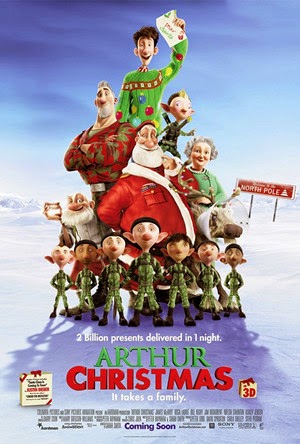
#1,583. Arthur Christmas (2011) - Spotlight on England


Directed By: Sarah Smith, Barry Cook

Starring: James McAvoy, Jim Broadbent, Bill Nighy


Tag line: "All elf breaks loose"

Trivia: First announced in 2007 under the title Operation Rudolph


One of the most common Holiday-related questions kids ask is “How can only one man (i.e. Santa Claus) deliver toys to all the children of the world in a single night?”

Arthur Christmas, a 2011 animated film co-produced by Sony Pictures and Britain’s Aardman Studios, answers that question thusly: He does it with a little help from his friends (a few thousand of them, actually).

It’s a common misconception that - since the dawn of Christmas - there has been only one Santa Claus. In fact, there have been twenty, all of whom can trace their ancestry back to the original St. Nicholas. The current Santa, Malcolm Christmas (voiced by Jim Broadbent), has held the job for 70 years, and is nearing the end of his reign. 

A lot has changed since Malcolm first became Santa. For one, he no longer uses a sleigh and eight tiny reindeer. Instead, Santa now cruises the world in the S-1, a massive airship that can travel at the speed of sound and has room enough for thousands of elves, who assist him during his Christmas Eve run by delivering the toys on his behalf. 

Santa’s oldest son (and heir apparent) Steve (Hugh Laurie) oversees the entire operation from the North Pole’s mission control center, while Steve's younger brother, the always-optimistic but somewhat clumsy Arthur (James McAvoy), has the thankless job of answering the millions of letters sent by children from all over the world.

Yet despite the technology at their disposal, no one notices until it’s too late that, at the end of Santa’s most recent run, a solitary toy was overlooked. For Steve, missing a delivery is no big deal (after all, they successfully handled over 2 billion packages that night), but for Arthur, the thought of a child’s Christmas being ruined is too much to bear. 

Hopping aboard the old sled that previous Santas had used for centuries, Arthur - along with his grandfather, aka Santa #19 (Bill Nighy) and an elf named Bryony (Ashley Jensen) - sets out for England, hoping to deliver the toy in time for Christmas morning. But will the antiquated sled make it there in one piece?

Right out of the gate, Arthur Christmas introduces us to a fascinating world in which Santa and his elves have gone high-tech. We watch as the S-1 makes its way into a city, and marvel as hundreds of elves drop from the ship onto the rooftops below, where, with military precision, they deliver gifts to thousands of children in a matter of minutes, using an assortment of gadgets to get the job done (one of the most interesting gizmos is a scanner that determines whether a child has been “good” or “naughty”). 

Equally as impressive is the mission control center, situated hundreds of feet below the North Pole, where Steve Christmas and a few thousand elves monitor the S-1’s progress. Aside from being very creative, these scenes establish the film’s overall tone, which can best be described as frantic. Even later on, when Arthur and his “GrandSanta” climb aboard the old sled, the energy remains at a fevered pitch, giving us one exciting sequence after another (at one point, Arthur and Grandsanta lose their way and land in Tanzania's Serengeti reserve, where they have a close encounter with a pride of lions).

Utilizing the voice talents of an all-star cast (which also includes the likes of Michael Palin, Imelda Staunton, Laura Linney, and Eva Longoria) and delivering a message of hope that is sure to resonate with many younger viewers, Arthur Christmas is one of the most original Holiday films to come along in years.


Tuesday, December 2, 2014

#1,569. Scrooge (1970) - Spotlight on England


Directed By: Ronald Neame

Starring: Albert Finney, Alec Guinness, Edith Evans


Tag line: "What the dickens have they done to Scrooge?... They've put him in a big, big musical"

Trivia: Alec Guinness did not enjoy doing this movie. It required much more time than he expected, with the need of wires and a harness for his floating character. He suffered a double-hernia that required surgery to repair


Now that December is upon us, I thought I’d ease my way into the Holiday season by reviewing a handful of the cinematic incarnations of Charles Dickens’ Yuletide masterpiece, A Christmas Carol. Having already covered the two best versions of the story (1951’s A Christmas Carol and its 1984 made-for-TV counterpart) as well as the funniest (Blackadder’s Christmas Carol), I figured I’d try my luck with a musical adaptation, which led me to 1970’s Scrooge.

Its song and dance numbers aside, the basic premise of Scrooge is pretty much the same: Ebenezer Scrooge (Albert Finney), who operates a successful moneylending business in the heart of London, is a miserable old skinflint who hates everyone and everything, including Christmas. To help him change his ways, the ghost of his former associate, Jacob Marley (Sir Alec Guinness), pays Scrooge a visit on Christmas Eve to tell him that three spirits, the ghosts of Christmas Past (Dame Edith Evans), Present (Kenneth More), and Future (Paddy Stone), will be stopping by during the night. 

Hopefully, these supernatural visitations will rekindle Scrooge’s long-dormant Christmas Spirit, but at the very least, they'll show the old penny pincher that all the money in the world won’t save him if he doesn't turn things around.

The usual cast of characters is on hand, including Scrooge’s long-suffering employee Bob Cratchit (David Collings), Bob's son Tiny Tim (Richard Beaumont), and Scrooge’s kindly nephew Fred (Michael Medwin). During his journey to the past, the old miser also encounters his former employer Fezziwig (Laurence Naismith) and his long-lost love Isabel (Suzanne Neve). 

Yet what makes Scrooge a success isn’t its adherence to Dickens’ tale, but the liberties it takes with it, starting with Finney’s performance, which, though unsettling at first (what with his hunched back and unusual way of talking), proves to be one of the most interesting takes on the character I’ve ever seen. 

In addition, some of the story’s key moments are handled a bit differently, including Marley’s visit to Scrooge (in a stunning sequence, both characters glide through the air, surrounded by the spirits of those who share Marley’s fate) and Scrooge’s trip to the future (which contains the best scene in the entire film, when Scrooge mistakes a public rally outside his office as a show of affection, never once realizing the actual reason everyone is celebrating). There’s even an extended sequence where Scrooge experiences what “life after death” might have in store for him. The most jarring change, however, occurs in the movie’s finale, a grand and glorious musical number that wraps up this particular version of Dickens’ classic tale in perfect fashion.

While the music is mediocre at best (the two exceptions being “December the 25th”, sung during the Christmas party at old man Fezziwig’s; and the extremely catchy “Thank You Very Much”, performed several times throughout the movie, but initially at the above-mentioned rally outside Scrooge’s business), Scrooge has plenty of personality, and in the end puts a very satisfying spin on a time-honored tale.


Monday, December 1, 2014

#1,568. A Christmas Carol (1951) - Spotlight on England


Directed By: Brian Desmond-Hurst

Starring: Alastair Sim, Jack Warner, Kathleen Harrison


Tag line: "Now! The story that has brought joy to millions! A new screen triumph!"

Trivia: This film was released in Great Britain under its original title, Scrooge


As I mentioned in my write-up of 1984’s A Christmas Carol, that movie will forever be my favorite take on Dickens’ classic tale. That said, I also hold a special place in my heart for 1951’s A Christmas Carol (released as Scrooge in the UK), which is as emotionally rewarding as any version ever produced.

It’s Christmastime in Victorian London, and the only person not celebrating is Ebenezer Scrooge (Alistair Sim), a mean-spirited miser whose only obsession is his money-changing business. Scrooge is so nasty that he refuses to donate money to help the poor, and is even cold towards his nephew, Fred (Brian Worth), his only living relative. In fact, it’s only begrudgingly that he allows his sole employee, Bob Cratchit (Mervyn Johns), to have Christmas Day off!

But this Holiday season has something special in store for Mr. Ebenezer Scrooge. Shortly after arriving home on Christmas Eve, Scrooge is haunted by the ghost of his former business partner, Jacob Marley (Michael Hordern), who tells him he must change his stingy ways and start tending to his real “business”: the welfare of mankind. To this end, Marley informs his associate that, during the night, he’ll be visited by three spirits: the ghosts of Christmas Past (Michael Dolen), Present (Francis de Wolff) and Future (C. Konarski), all of whom will work in unison to show Scrooge the error of his ways. 

Will Scrooge learn to open his heart to the world, or is he destined to die alone… and despised?

One way this version of A Christmas Carol differs from the ’84 film is the amount of time it spends with the Ghost of Christmas Past. Approximately half the picture (perhaps more) is dedicated to Scrooge’s visit to his younger self (played by George Cole), showing us the loving relationship he had with his sister Fan (Carol Marsh), including a scene where Fan is on her deathbed, at which point the elderly Scrooge finally hears his sister’s dying wish (one of the film’s most poignant moments). 

As with the ’84 movie, Scrooge is also forced to re-experience his whirlwind romance with Alice (Rona Anderson), a penniless girl to whom he was engaged prior to making his fortune; as well as his time spent as an apprentice at the shop owned by the kindly Mr. Fezziwig (Roddy Hughes), who tried unsuccessfully to teach Scrooge that there was more to life than money.

In addition, we're treated to the backdoor dealings that made Scrooge and Marley partners, and how, years later, Scrooge refused to visit the dying Marley until the day’s business had concluded. The scenes set in the past show us a kinder Scrooge, but they also reveal how his heart was hardened to the world, and the shame of it all is too much for the older Scrooge to bear (he’s continually asking the Ghost of Christmas Past to cease the visions and return him home). 

The movie does spend some time in "Christmas Present", including a sequence at Bob Cratchit’s house featuring his sickly son, Tiny Tim (Glyn Dearman); and the scenes set in the future are every bit as chilling as they were in the ’84 version, but it’s Scrooge’s past that made him the man he is, and this film takes its time unveiling the events that transformed an ambitious young man into a greedy, angry older one.

Alistair Sim is remarkable as Scrooge (both when he’s mean and when he’s a changed man), and an added sequence towards the end featuring his housekeeper Mrs. Dillber (Kathleen Harrison) starts Scrooge's Christmas Day reformation off on a humorous note. But it’s the depth of feeling the movie stirs in its audience, helped along by Scrooge’s visit to the past, that resonates strongest. 

Charles Dickens' A Christmas Carol has always been a moving, life-affirming story, and thanks to Alistair Sim and his wonderful co-stars, this particular film version is guaranteed to move you to tears.