“It’s a fascist film. It’s a vile film. It’s an idiot film”.
A strong reaction, certainly, but then The Big Racket is the kind of movie that will elicit such a response.
There are scenes that hit you like a ton of bricks, moments so disturbing they will stay with you for days. And the criminals in The Big Racket are detestable. Think of the worst gang of thugs and lowlifes in any movie you’ve seen, and chances are they won’t hold a candle to the villains in this film.
And yet, despite its harsh and gritty approach, Castellari directs The Big Racket with gusto, and even some panache, making it a whole lot more than your run-of-the-mill violent crime flick.
Gangs roam the streets of a small neighborhood in Rome, extorting “protection” money from shop owners and businessmen, often demanding sizable payments they cannot afford. If these merchants don’t cough up the cash, they are beaten and their businesses are destroyed. Detective Palmieri (Fabio Testi) has been trying to rid the area of this vermin for years, only to find that the victims are scared, and never willing to press charges.
Then, restaurant owner Luigi (Renzo Palmer) decides he’s had enough, and agrees to cooperate with Palmieri. The criminals respond by kidnapping Luigi’s daughter and raping her.
When his superiors, who fear he’s become too emotionally attached to the case, prevent Palmieri from getting involved any further, the disgruntled cop rounds up a few equally pissed cohorts, including Luigi; small-time crook Pepe (Vincent Gardenia); and champion sharpshooter Gianni Rossetti (Orso Maria Guerrini), whose own wife, Anna (Anna Zinnemann), also suffered the cruel abuse of the gangs. Employing their own brand of vigilante justice, they take the fight to the crooks, hoping to end this reign of terror once and for all.
The Big Racket is a violent film. It is unflinching. The rape of Luigi’s daughter is tough to watch, but there is another scene later in the film (with Gianni and his wife) that is tougher.
Castellari also borrows heavily from earlier films such as Dirty Harry and Death Wish, which favored vigilantism over law and order. Yet by the time Detective Palmieri puts his team together (making the final act of The Big Racket a kind of Dirty Harry meets Castellari’s own 1978 film The Inglorious Bastards), we the audience are one with their cause, and happily put our own morality on the backburner. We are cheering the vigilantes on because the criminals in this film are loathsome (a tribute to the actors and actress who play them). We hate this scum, and cannot wait to see each and every one get their just desserts.
We know we shouldn’t feel that way, but we do. Castellari has pulled the strings perfectly, and we go where he leads us, accepting that, yes, the final showdown happens exactly how it needs to happen.
Part of the reason Castellari pulls this off is that he infuses The Big Racket with tons of style. Amidst all the carnage and ugliness are some impressively staged sequences, chief among them an early encounter between Palmieri and the crooks, in which the thugs destroy Palmieri’s car while he’s still inside it, then roll it down a hill. Shooting half of this sequence from the car’s interior, we watch as Fabio Testi (doing his own stunt work) tumbles over and over again in a rolling vehicle. It is as awe-inspiring as it is terrifying. There are even a few moments of beauty, like a brief scene in which Palmieri, recovering from the wounds, strolls along a beach as the setting sun illuminates the sky.
Employing these as well as slow-motion, and combining it all with convincing violence (I couldn’t count the number of squibs used during the shootouts); impressive locations (one scene is set in the Roman Forum); and an over-the-top, often comedic performance by Vincent Gardenia, whose Pepe is the sole likable crook in the entire movie, Castellari manages to make the terrible and grotesque more palpable.
And when you watch The Big Racket, you will realize this was no small accomplishment.
Rating: 9 out of 10

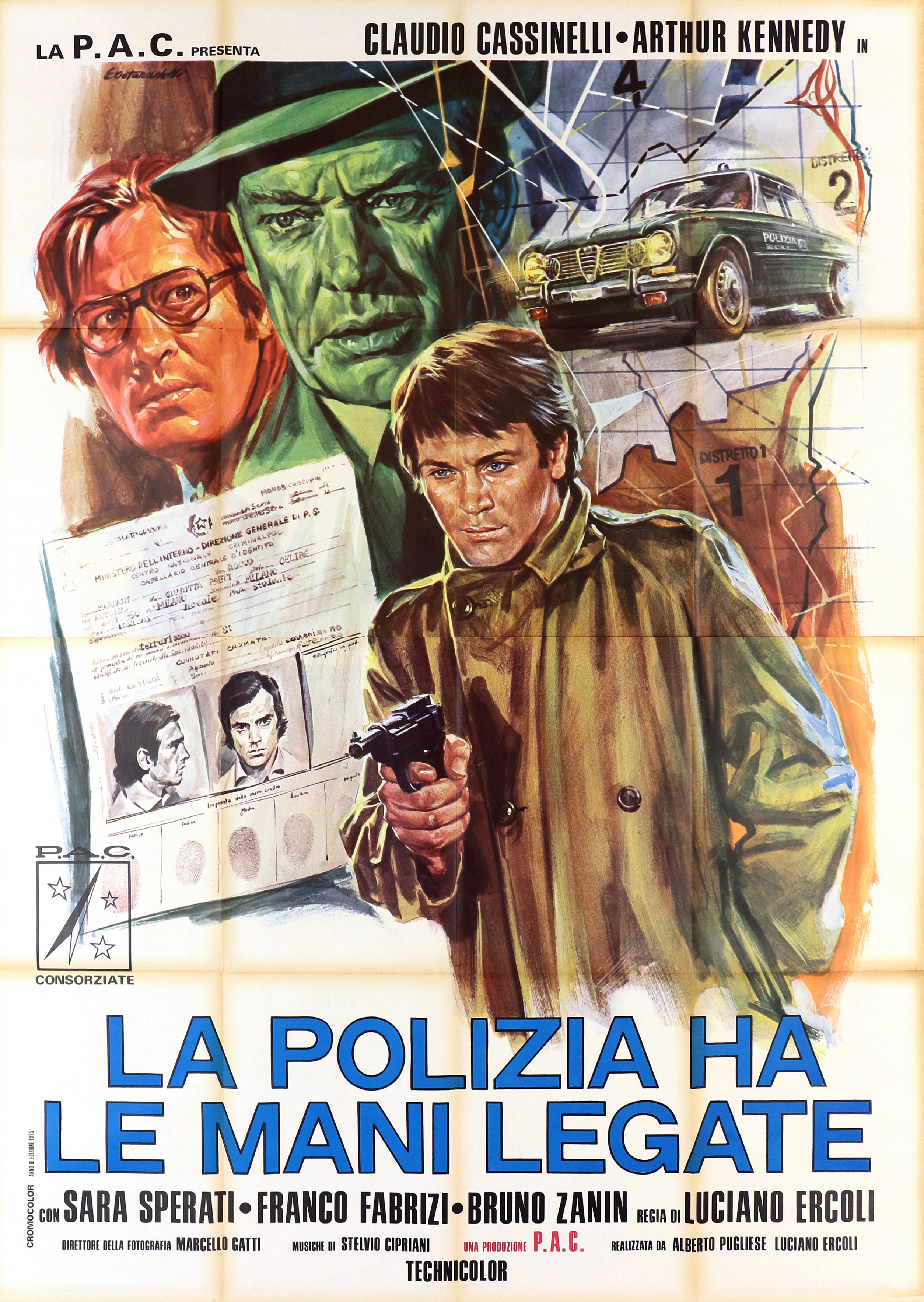
The police do, indeed, have their hands tied throughout Killer Cop. While searching the hotel room of an international drug dealer, inspector Matteo Rolandi (Claudio Cassinelli) of the Milan police is caught in the middle of a terrorist attack; a bomb, hidden inside a suitcase, explodes in the hotel’s lobby.
The young political activist who planted the bomb, a guy we later find out is named Franco (Bruno Zanin), tried to retrieve the suitcase before it exploded, and even warned everyone to run just before it went off. That’s because Franco realized, at the last minute, that he accidentally planted a much larger explosive than originally intended. Feeling guilty, the young man (who lost his glasses while attempting to get the suitcase back) hops a bus and rides it for a few stops.
When he gets off the bus, Franco writes an apology on a newspaper and leaves it in a nearby phone booth. Unfortunately for Franco, Police Inspector Balsamo (Franco Fabrizi) was also on this bus, and, noticing the young man’s nervous disposition, retrieves the newspaper, reads it, and immediately gives chase. Franco escapes, but not before Balsami gets a good look at him.
As the only person who can identify the bomber, Balsami is placed in protective custody, and takes up residence at the home of Armando Di Federico (Arthur Kennedy), the gov’t official put in charge of investigating the bombing. Unfortunately, Franco’s associates still get to Balsami, and he is gunned down.
Anxious to find out who is behind both the bombing and Balsami’s assassination, Inspector Rolandi, though not assigned to the case, does a little investigating of his own, all as Franco and his associates, Rocco (Paolo Poiret) and Falena (Valeria D’Obici), are somehow staying one step ahead of the law.
What Rolandi and Di Federico don’t know, however, is that there are greater forces at work, and a few individuals very close to them, government employees like themselves, might know more than they are letting on.
Along with acting as a time capsule of the socio-political climate in Italy the mid-‘70s, Killer Cop was also inspired by true events, specifically the 1969 Piazza Fontana bombing in Milan. This brings a chilling sort of realism to the film, and sets the stage for what will prove to be an involving and very cool procedural, both from the perspectives of the law and the lawbreakers.
We watch as Rolandi ignores protocol to get a look at some important evidence in police storage, then enlists the help of a number of opticians, figuring that Franco, who is near blind without his glasses, will try to get a new pair at some point. We also sit in with Di Federico as he wrestles with both the country’s Information bureau (who are demanding to be included in the investigation) and his own conscience (for not better protecting his star witness, Balsami).
But director Ercoli also brings us into the world of the bomber, Franco, and his compatriots, who run into a little trouble of their own when they attempt to flee Milan. Ercoli and writer Gianfranco Gallgarich ensure that both sides of this story are given ample screen time before merging into one in the final act.
I also loved how Ercoli referenced other well-known crime films throughout Killer Cop. The killing of Balsami, from the area where he’s gunned down to the fact he was shot in the back, felt like an homage to the shooting of Don Corleone in 1972’s The Godfather (both occur while the intended victim was shopping for fruit at a streetside stand). Also, late in the film, there’s a scene where Rolandi is chasing down Papaya (Sara Sperati), an informant who purposefully misled him. Suddenly, a shot rings out. The way Ercoli frames this incident, then follows the gunman into the subway, reminded me of a similar moment (or two moments together) from William Freidkin’s award-winning The French Connection.
These cinematic tributes aside, this is a first-rate thriller with chases and gunplay aplenty, and will keep you poised on the edge of your seat.
Even as you’re asking yourself why the hell did they call it Killer Cop?!?
Rating 8.5 out of 10

Former Milanese gangster Ugo Piazzi (Gastone Moschin) has just been released from prison. Moments after he hits the streets, Ugo is approached by former associate Rocco (Mario Adorf), who works for a powerful American crime boss (played here by Lionel Standler). Both Rocco and “The Americano” are convinced it was Ugo who made off with the money that went missing (in the pre-title sequence), then got himself arrested to throw them off his track.
Ugo claims he is innocent, though very few people believe him, including his former flame Nelly (Barbara Bouchet). Feeling the heat, Ugo asks for help from his old friend Chino (Phillippe Leroy), the sole remaining capo of the elderly Don Vincenzo (Ivo Garrini). But Chino refuses.
To keep an eye on Ugo, “The Americano” brings him back into the fold and orders him to work alongside Rocco, carrying out odd jobs. Everyone believes Ugo will eventually try to retrieve the money, but he insists that he is only sticking around to clear his name, and track down the real thief.
The entire cast of Caliber 9 is nothing short of amazing. Gastone Moschin, who that same year would play the ill-fated Don Fanucci in The Godfather Part II, is enigmatic as hell in the role of Ugo, leaving everyone, including the audience, in the dark as to whether or not he's the one that stole the mob’s money. Mario Adorf’s Rocco is the perfect counterbalance to Moschin, a flamboyant, violent gangster who harasses Ugo every chance he gets.
Also on Ugo’s back is Milan’s Police Commissioner, played by Frank Wolff, who, despite his distaste for the criminal underworld, tries to cut a deal with Ugo, offering him protection and even money in exchange for information. Rounding out the cast are the lovely Bouchet as Ugo’s go-go dancer girlfriend and Lionel Standler as the “Americano”, the most influential man in Milan.
Yet what truly impressed me about Caliber 9 was its pacing. DiLeo keeps the film moving along briskly, with one well-directed scene after another. This is especially true of the pre-title opening. It contains no dialogue whatsoever, and even though, at the outset, we haven’t the foggiest idea what is going on, or who the characters are, DiLeo shoots it with such precision and style that we eventually figure it out. Topping this, however, and every other great scene in this movie, is the twisting, turning final act, which features one grab-you-by-the-throat surprise after another.
Take all of the above, and throw in an intelligent story (the film gets its title from a collection of short tales by Giorgio Scerbanenco), and you have one hell of a motion picture. Caliber 9 is a Euro-crime masterpiece.
Rating: 9.5 out of 10