Showing posts with label Anthony Mann. Show all posts

Friday, May 21, 2021

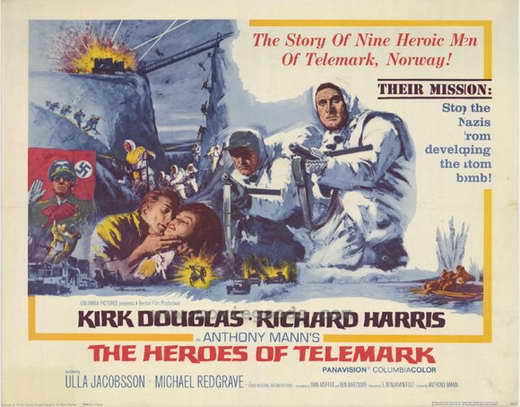
#2,571. The Heroes of Telemark (1965) - Kirk Douglas Film Festival


Anthony Mann directs this large-scale yet strangely lifeless war film, which is based on a true story.

The setting is Nazi-occupied Norway, 1942. Scientist Rolf Pedersen (Kirk Douglas) joins forces with resistance leader Knut Straud (Richard Harris) to sabotage a hydro plant in the small town of Rjukan, which is producing heavy water for the Nazis, a key component in the manufacturing of atomic bombs.

Aided by a small band of fighters, including Pedersen’s ex-wife Anna (Ulla Jacobsson) and her Uncle (Michael Redgrave), they put their plan into motion, knowing full well what it means to rest of the world if they fail.

Mann, who also directed The Fall of the Roman Empire and El-Cid, brings an epic sensibility to The Heroes of Telemark, and there are a handful of big moments scattered throughout the film. Hoping western scientists can shed some light on the Nazis intentions, Pederson, Straud, and a few others hijack a passenger ship and force it to sail to London, resulting in a few tense moments when their boat encounters some mines.

Once word arrives that the Germans do, indeed, intend to build atomic weapons, the decision is made to sabotage the plant, leading to another exciting sequence, while the film’s finale, set aboard a ferry, is positively nerve-racking.

Where The Heroes of Telemark falters is in its characterizations. Douglas and Harris do a fine job as the mismatched freedom fighters: Pedersen takes a more practical approach to the situation, realizing it might be necessary to sacrifice a few innocent civilians for the greater good, while Straud fights tooth and nail for a plan that will spare the lives of his friends and neighbors. Unfortunately, the two never click as a team (there was supposedly friction between Douglas and Harris throughout production, and it shows in their scenes together).

Worse still is the relationship between Pedersen and his ex-wife Anna, which is so woefully underdeveloped that it feels like an afterthought (making the scene where Pedersen crawls into bed with Anna more predatory than romantic).

It may seem a bit nit-picky to complain about poorly developed characters in an action-centric war film, and as I said, the movie boasts a fair number of exciting sequences. But in a story with so much on the line, you can’t completely ignore the human element, and the fact that The Heroes of Telemark comes up as short as it does in that department simply cannot be overlooked.
Rating: 5.5 out of 10


Sunday, July 17, 2016

#2,145. Bend of the River (1952)


Directed By: Anthony Mann

Starring: James Stewart, Rock Hudson, Arthur Kennedy


Tag line: "The greatness...the glory...the fury...of the Northwest Frontier!"

Trivia: Some of the river scenes were filmed on the Sacramento river in northern California


James Stewart certainly played his share of nice guys throughout his career, from town banker George Bailey in It’s a Wonderful Life to the uber-friendly and gloriously insane lead in Harvey. But during the handful of westerns he made with director Anthony Mann, the actor stretched his boundaries a bit, giving his “aw shucks” persona a rest in order to portray dark, conflicted characters. In short, he was a bad-ass in these movies, and 1952’s Bend of the River was no exception.

Glenn McLintock (Stewart) is leading a wagon train of settlers westward to Oregon, where they hope to build a new life for themselves. While out scouting for a possible shortcut, he interrupts the lynching of Emerson Cole (Arthur Kennedy), who has been accused of cattle rustling. Not willing to sit back and watch a man hanged by his neck, McLintock rescues Cole, and the two become fast friends. Following an Indian attack, during which Laura (Julia Adams), the daughter of settler Jeremy Baile (Jay C. Flippen), is injured, the band of travelers makes its way to Portland, where they meet gambler Trey Wilson (Rock Hudson) and riverboat captain Mello (Chubby Johnson), among others.

It’s here that McLintock and Cole part ways (Cole talks of heading to California to look for gold, while McLintock is determined to help Baile and the others build a community in the Oregon wilderness). After striking a deal with Portland businessman Tom Hendricks (Howard Petrie), paying him in advance for supplies to be delivered to their new settlement just before winter, McLintock and the pioneers press on, leaving Laura behind to recover from her wounds.

Several months pass, and the settlers, having reached their ultimate destination, are worried because Hendricks has yet to show up with their supplies. To find out what’s happened, McLintock and Baile return to Portland, where they discover a town now booming thanks to the recent gold rush. Cole (who never did get to California) and Trey Wilson have opened up their own casino, and are raking in tons of money. What’s more, Cole is now romantically involved with the fully-recovered Laura, and plans to marry her as soon as possible. To make matters worse, Hendricks, realizing the gold prospectors will pay him more, has reneged on his promise, and refuses to release the supplies. This leads to a showdown in the streets of Portland, during which McLintock, aided by Cole and Trey Wilson, steals the supplies and escapes on Captain Mello’s boat. But before they reach the new settlement, McLintock and Baile will learn that Hendricks isn’t the only one suffering from “Gold Fever”.

As played by Stewart, McLintock is an honorable man who always keeps his word, but there are hints that he’s also running from his past (he was a raider during the Civil War, and did things he clearly isn’t proud of). Helping Baile and the others is his way of setting things straight, but don’t think for a minute that McLintock’s desire to change has weakened his resolve in any way. During the attack that injured Laura, he and Cole rush into the surrounding woods to take on the Indians, with each man saving the others’ life before the melee is over. In addition, McLintock gets ornery as hell when someone double-crosses him (as Hendricks quickly discovers). Stewart does a remarkable job bringing this complex character to life, embodying the decency as well as the inner fire that steers his actions.

Yet as good as Stewart is, it’s the overall flow of the film, the organic way in which its story unfolds, that impressed the hell out of me. Like all of Mann’s westerns (The Furies, Winchester ’73, The Naked Spur, etc)., Bend of the River moves effortlessly from one situation to the next, turning its back on formula and convention in favor of a more natural form of storytelling (the showdown with Hendricks in Portland is followed by the escape on Captain Mello’s steamboat, which then evolves into some tense scenes on-land when McLintock faces dissention within his own ranks). As a result, we the audience are swept up by what’s happening on-screen, watching intently with no idea what’s coming next (Mann’s westerns are never predictable).

There’s a spirit of spontaneity that permeates throughout Bend of the River, which, combined with Stewart’s superb performance, makes for an exciting and altogether unique motion picture.


Monday, November 21, 2011

#462. The Furies (1950)


Directed By: Anthony Mann

Starring: Barbara Stanwyck, Wendell Corey, Walter Huston


Trivia:  This was Walter Huston's final film


The Furies was shot entirely in black and white; but then it couldn’t have been done any other way. With its brooding story and dark, complex characters, there wasn't a color in the spectrum that could have penetrated this film. 

The year is 1870; the setting, New Mexico. T.C. Jeffords (Walter Huston, in his final screen appearance) is a former cattle baron whose wealth helped him build an enormous ranch, which he named the Furies. His daughter, Vance (Barbara Stanwyck), has a lot in common with her father, including his love of the Furies. 

T.C. has fallen on hard times, and owes money all over the territory. He has promised to turn the ranch over to Vance one day, convinced she is the only person capable of running it the way it needs to be run. But a love of the Furies isn’t the only thing father and daughter share; both are headstrong, and clash over everything from potential husbands for Vance to how to handle the squatters that have, for years, been trespassing on their land. 

When T.C. openly rejects a series of suitors for Vance, the stage is set for a face-off that ultimately threatens to destroy not only their relationship, but the Furies as well. 

Huston and Stanwyck are stellar as T.C. and Vance, two individuals so incredibly alike, sharing the same boisterous, egotistical personality, that their falling out was inevitable. At the wedding reception for T.C’s son, Clay (John Bromfield), who has always taken a back seat to his more ambitious sister, a rival of T.C.'s named Darrow (Wendell Corey) turns up. T.C, who had shot and killed Darrow’s father years earlier, insults Darrow and orders him to leave, at which point Vance turns to their unwanted ‘guest’ and asks him to dance. Before long, Darrow and Vance are dating, and even talking of marriage. It’s an open challenge to T.C., who earlier had presented Vance with a dowry of $50,000, which he promised to turn over only if he approved of her choice of husband. Less a courtship than a showdown between father and daughter, it is the first in what will become a series of standoffs between the two. 

There aren't many likeable characters in The Furies, and while we do feel a certain degree of sympathy for T.C. and Vance, these feelings shift back and forth between the two, never once coming to rest on both at the same time. T.C. and Vance loom over the film like a dark cloud, in much the same way they hang over the Furies ranch and everyone who resides within it. 

From the moment we meet T.C. and Vance, we sense a storm is brewing, and heaven help anyone caught in the middle of it.


Friday, September 9, 2011

#399. Winchester '73 (1950)


Directed By: Anthony Mann

Starring: James Stewart, Shelley Winters, Dan Duryea


Trivia:  James Stewart has credited Winchester '73 for helping to save and redefine his career


Of the five westerns that James Stewart made with director Anthony Mann, 1950’s Winchester ’73 is the best. Moreover, I rank it as one of the finest westerns ever made…period. Relying on a narrative that is entirely free-flowing, Winchester '73 never once gets mired in the stale confines of Hollywood formula.

Lin McAdams (Stewart) has just won a sharpshooting contest, the grand prize being an 1873 model Winchester rifle, considered by many the finest ever built. When Dutch Henry Brown (Stephen McNally) - a wanted man that McAdams has been tracking for years - knocks him unconscious and steals the rifle, McAdams and his sidekick, High Spade (Millard Mitchell), set out to recover it.

Will McAdams catch up with Dutch Henry Brown in time to retrieve his '73 Winchester, or will the elusive outlaw once again give him the slip?

That's the basic premise, but before the end credits roll, Winchester ’73 will have branched off in many different directions. The moment Brown steals the rifle from McAdams, he and his men ride off into the desert, skipping town so quickly that they were forced to leave their sidearms behind. Along the way, they meet a trader (John McIntire), who offers to buy the Winchester from Brown for $300. In need of new guns for his men, Brown has little choice but to sell his ill-gotten prize.

The trader, in turn, sells the rifle to Chief Young Bull (Rock Hudson), who uses it during an attack on a Pennsylvania Cavalry Unit. Following the battle, the Winchester is retrieved by a soldier named Doan (a very young Tony Curtis), and immediately turned over to Steve Miller (Charles Drake), who helped the Cavalry unit fight off the attack.

You would be correct in assuming that Miller won't be the last to own this fine rifle. Under Anthony Mann's watchful eye, Winchester '73 constantly moves forward, from one situation to the next, in a perfectly organic manner. Unlike many of his contemporaries, Mann realized the stories of the American West, at least the ones he was interested in exploring, were never told in three acts.

Winchester ’73 is undoubtedly a classic of the genre, but I would also recommend checking out the other Stewart/Mann western collaborations (Bend of the River, The Naked Spur, The Far Country and The Man from Laramie), all wonderful films in their own right. Each features a structural arc more or less like the one in Winchester ’73, where the only predictable element is unpredictability. Working within a genre that boasted a rich and vibrant history, Anthony Mann managed to stand apart from the rest, and Winchester ’73 is the pinnacle of his individuality.


Saturday, July 9, 2011

#337. The Man From Laramie (1955)


Directed By: Anthony Mann

Starring: James Stewart, Arthur Kennedy, Donald Crisp


Tag line: "THE MAN You'll Never Forget!"

Trivia:  The film has been described as a western version of King Lear


The Man from Laramie marked director Anthony Mann’s first experience with Cinescope, a widescreen format introduced in the early 1950’s. By filling the entire screen with action, Mann took his western in a completely new direction, and within his typically well-composed tale of drama and intrigue introduced a little bit of art as well, providing his audience with the added bonus of breathtaking imagery to go along with a story they could sink their teeth into. 

Will Lockhart (James Stewart) has spent a great deal of time searching for the man who murdered his brother, even though he’s not entirely sure who that man might be. Knowing only that the killer trades guns with the Indians, Lockhart travels to Apache territory in the hopes of catching a break. Once there, he runs afoul of the bad-tempered Dave Waggoman (Alex Nicol), son of powerful rancher Alec Waggoman (Donald Crisp). Left wounded by the run-in and forced to stay put for a while, Lockhart soon finds himself square in the middle of a family squabble, with Dave Waggoman going up against his adopted brother, Vic Hansbro (Arthur Kennedy), for control of their father's vast estates. 

The Man from Laramie has many of the elements you'd expect to find in an Anthony Mann western, where vigilante justice is preferable to law and order and family members fight each other for control of a piece of land. Throw in an extra wide screen, and you have a movie that is truly unforgettable. With the hep of his Director of Photography, Charles Lang (who received 18 Academy Award nominations over his 47-year career), Mann utilizes every inch of his available canvas to relate this story of deception and revenge. From the opening scene, where two horse-drawn wagons make their way across a desert landscape, it’s obvious the director plans to take full advantage of the Cinescope format, and even the sudden moments of violence are stylized, like when Lockhart, on his first meeting with Dave Waggoner, is roped by one of Waggoner’s henchmen and dragged ten feet across the dirt and sand. It’s a terrible sight, to be sure, yet thanks to Cinescope, it's also quite spectacular. 

The Man from Laramie is an example of an artist working within a genre he is wholly familiar with, while at the same time employing technology that's entirely new to him. The result is a film of incredible power, not to mention incredible beauty.


Saturday, May 21, 2011

#288. The Naked Spur (1953)


Directed By: Anthony Mann

Starring: James Stewart, Janet Leigh, Robert Ryan


Tag line: "Packed with Technicolor Thrills!"

Trivia:  When this film was released in Spain, its title was changed to "Colorado Jim"


James Stewart teamed with director Anthony Mann on five westerns, starting with Winchester 73 in 1950 and continuing through to 1955’s The Man from Laramie. Aside from turning out five excellent films (which also included Bend of the River and The Far Country), this pairing marked a change of pace for Stewart. Gone was the disillusioned do-gooder of Mr. Smith Goes to Washington; the loveable underdog of It’s a Wonderful Life; and the eternal optimist of Harvey. Under Mann’s skillful direction, Stewart explored intense characters, men hardened by life who were looking for a way to come out on top, whatever the cost. In thee movies, James Stewart got his chance to walk on the dark side, and by all appearances he was just as comfortable in the shadows as he was the light. 

Howard Kemp (James Stewart), a bounty hunter from Kansas, has been tracking wanted murderer Ben Vandergroat (Robert Ryan) for hundreds of miles. With the help of two partners he picked up along the way: unlucky prospector Jesse Tate (Millard Mitchell) and dishonorably discharged Union soldier Roy Anderson (Ralph Meeker), Kemp does finally capture both Vandergroat and his companion, Lina Patch (Janet Leigh), a young girl the fugitive has been looking after for some time. 

Unfortunately for Kemp and the others, the journey back to Kansas to collect the $5000 bounty is fraught with dangers on all sides, not the least of which is the threat they pose to one another once greed rears its ugly head.  Before long, each man is looking for a way to claim the reward for themselves. 

As with many of Mann’s films, there are no clear-cut heroes in The Naked Spur, nor are there any obvious villains. Stewart’s Kemp is bound and determined to bring a wanted man to justice, but only so he can collect the reward. The fact that Vandergroat may actually be innocent means nothing to him. “it’s him they’re paying the reward on”, he reasons. Kemp even tries at one point to swindle Roy and Jesse, who helped capture Vandergroat, out of their share of the bounty. 

On the reverse side of the coin, Vandergroat is wanted for murder, but has also set himself up as a father figure to Lina, the daughter of his deceased best friend. Vandergrost has gone out of his way to care for the young girl, even if he does use Lina from time to time to stir up tension between Kemp and his ‘partners’. Then there’s Roy, a soldier who was thrown out of the army for taking up with an Indian chief’s daughter (whether the chief’s daughter was a willing partner or not is never disclosed). Wonderfully portrayed by Ralph Meeker, Roy has a nasty disposition, and makes unwanted advances towards Lina every chance he gets. 

With the line separating good from evil erased, none of the individuals in The Naked Spur are particularly trustworthy, character traits that bring a level of unpredictability to the proceedings.  With each man capable of any action, right or wrong, we the audience have no idea what to expect from scene to scene.

And that, my friends, is what makes an Anthony Mann western such a rewarding experience.